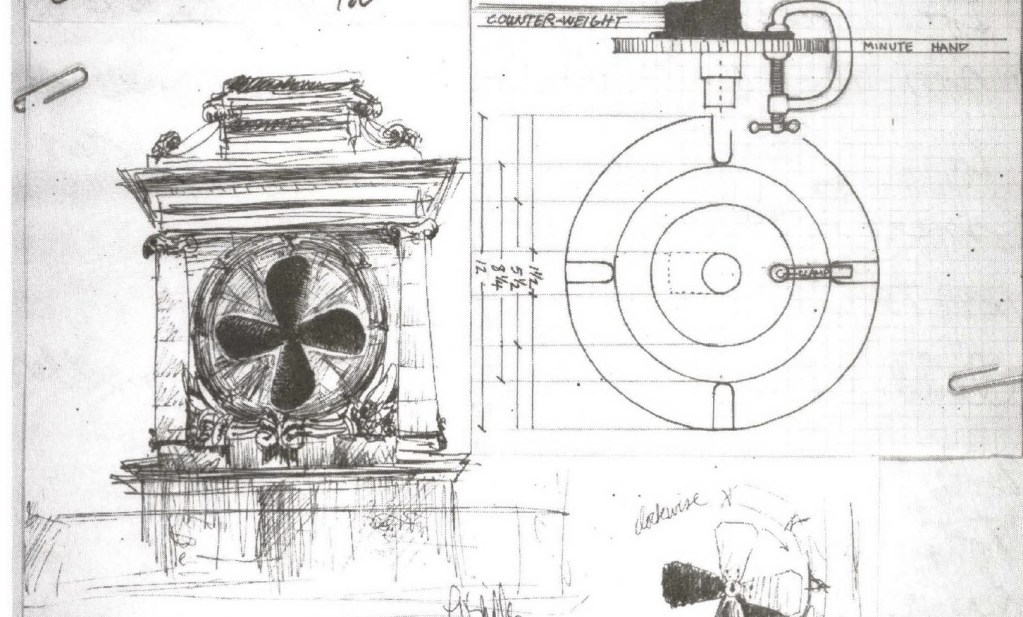

‘Very Fast Clock’ / ‘Very Slow Fan’ (~1975) by Larry Miller and George Maciunas – Radio Fluxus: Stories from the Fluxus Archives
The concept of switching motors between a fan and a clock was conceived by Larry Miller around 1973-74. According to Miller, “the work addresses the concept of a pairing of time and motion as two opposing ideas—sometimes referred to as a complementary ‘art conundrum’ or an ‘aporia’ [in rhetoric, a state of puzzlement or doubt]—wherein a fan, normally running quickly, and a clock, normally running slowly, are flipped to their opposing speeds.”[1]
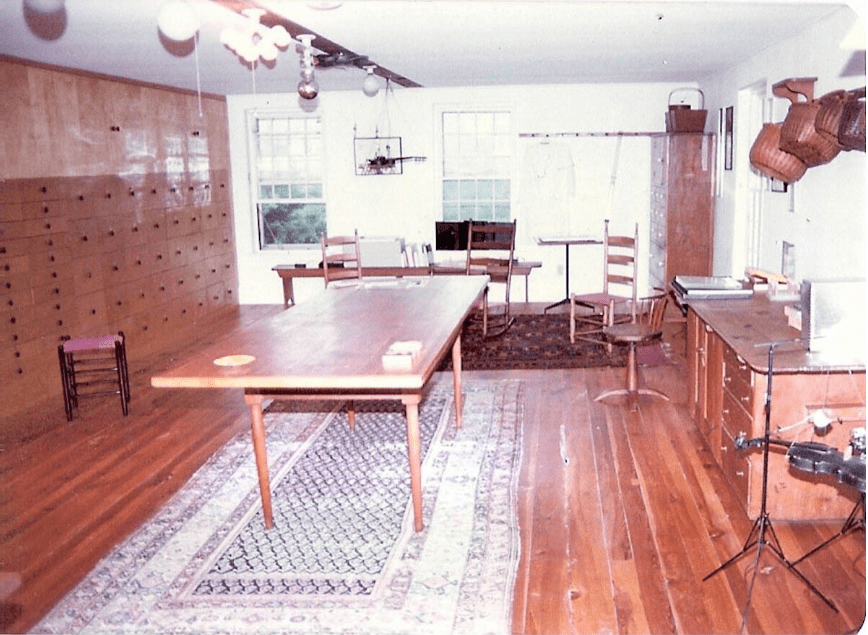
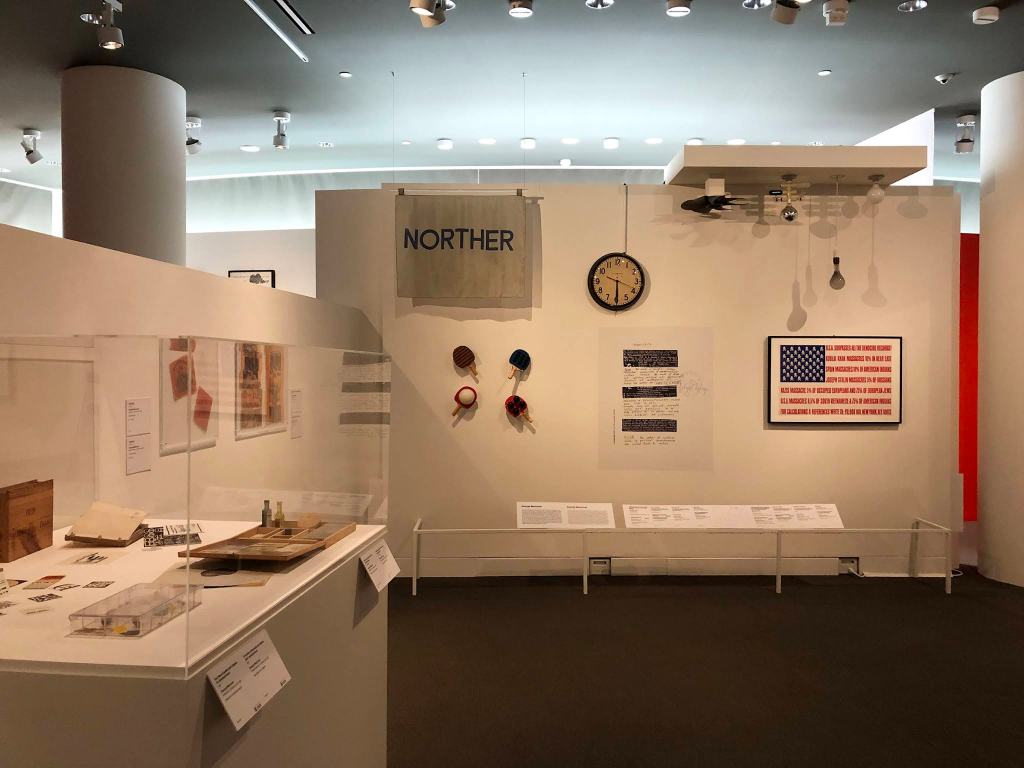
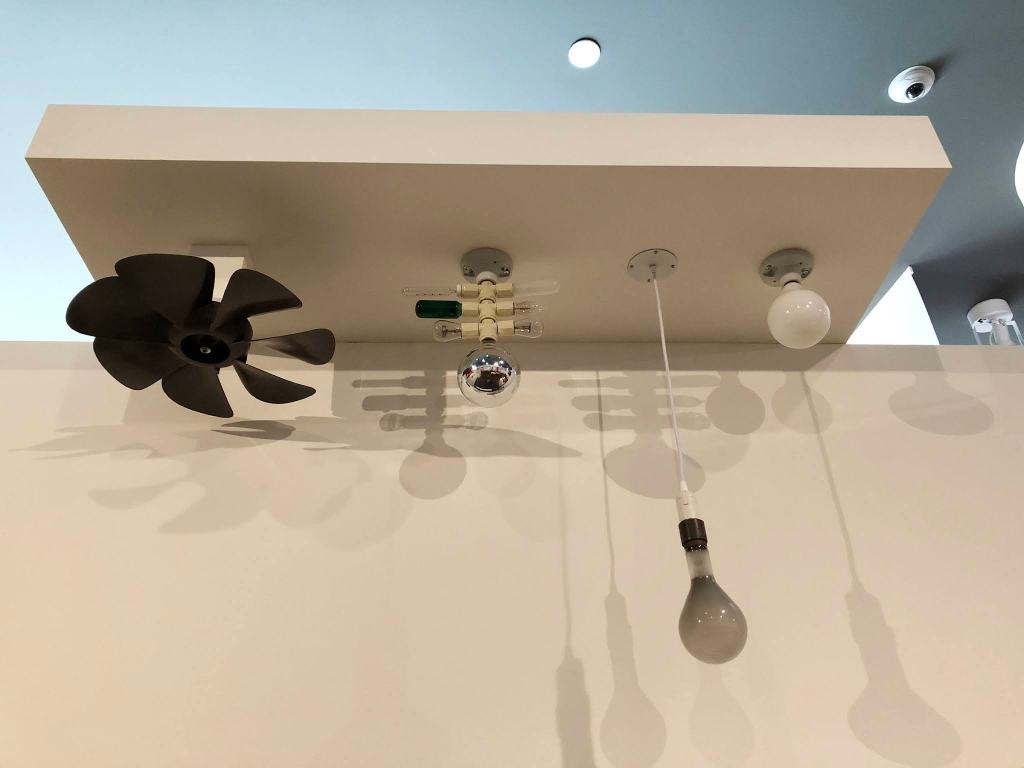
He shared the concept/score of “Very Fast Clock and Very Slow Fan” with George Maciunas, who created around 1975 a version specifically for a house of a collector Jean Brown in New Hampshire.[2] This version consisted of a large industrial-looking gray plastic fan with seven blades and large wall clock from the 60s/70s typical of American kitchens. The fan was installed on the ceiling while the clock was placed on the wall (Fig. 1).
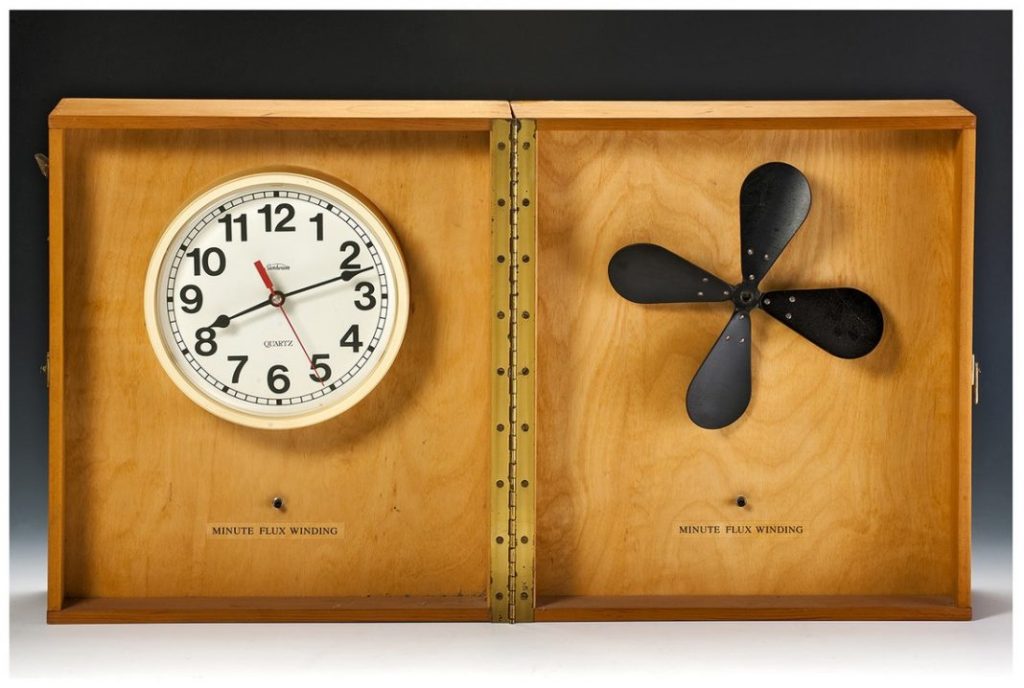
Larry Miller later created his own more portable and self-contained version of the concept under a title Minute Flux Winding. Miller explains: “The double meanings of the words ‘Minute’ and ‘Winding’ are both operant: the English language allows for two pronunciations for both the words ‘Minute’ (meaning both ‘units of time’ or ‘very small’) and ‘Winding’ (meaning a mechanistic action, or a motion of air—movement one may call ‘wind’—the very SLIGHT movement of motion and subsequent air).[3]” Between 1980 and 2009, Miller produced four different editions of this work. Minute Flux Winding Nr. 3 (1982-1990) has been acquired by mumok—Museum moderner Kunst Stiftung Ludwig Wien.
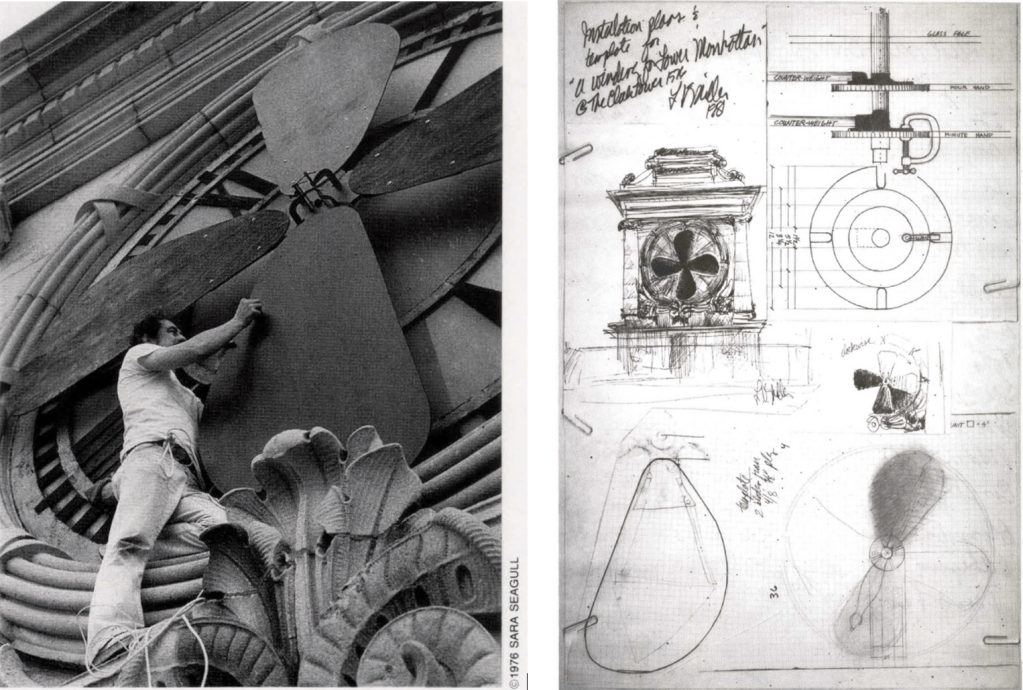
Another realization of the fan-clock pairing by Larry Miller Winding for Lower Manhattan, was at the “Delayed Flux New Year’s Event” in 1976.[4] Within the context of a group exhibit on the theme of “Time,” this piece took place at The Clocktower, performance gallery in Manhattan, New York. For this site-specific event, Miller mounted four giant fan blades onto the top of the building’s non-functioning clock. The blades were turned very slowly by an intricate mechanism designed and operated by the artist, that worked by only manual force.[5]
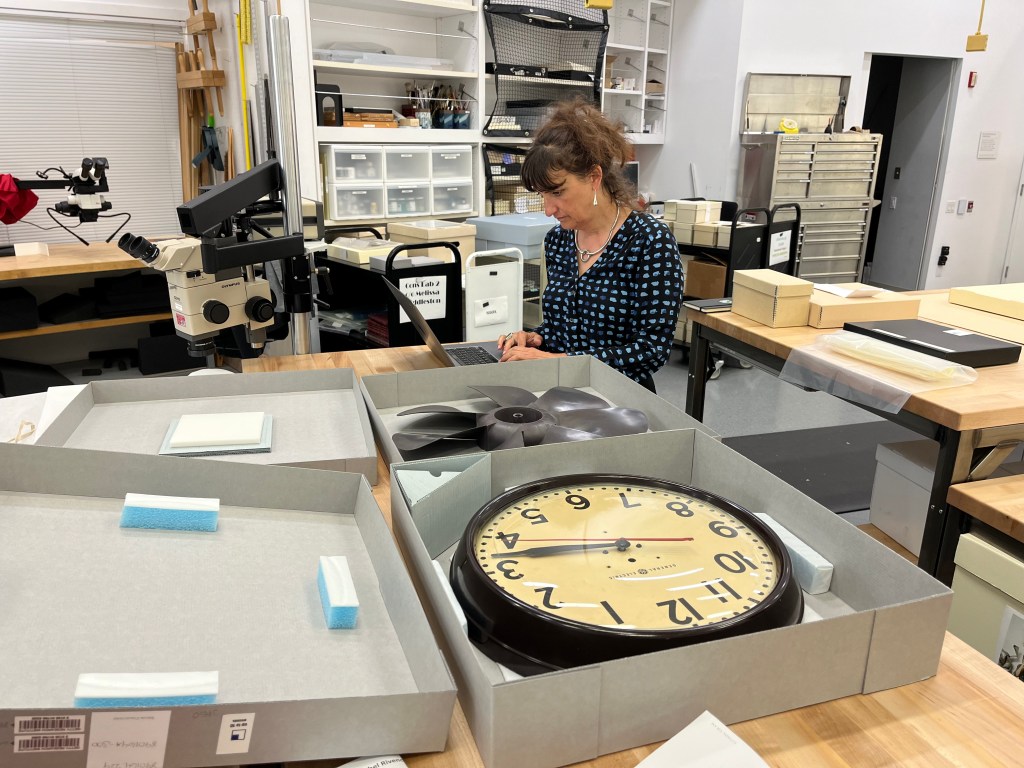
In this episode of Radio Fluxus, Rachel Rivenc examines the Miller/Maciunas version acquired by the Getty Research Institute archives as part of the study collection “Jean Brown papers 1916-1995”. The story guides the audience through the process of discovering, researching, and preparing the work for the exhibition “Fluxus Means Change: Jean Brown’s Avant-Garde Archive” at the GRI (Getty Center), which ran from September 14, 2021, through January 2, 2022. Rivenc’s exploration guides the public through the circumstances of the work’s existence in the GRI holdings as two separate objects (with two separate accession numbers and titles) and is complemented by thoughtful reflection on the conceptual and practical challenges of displaying and conserving concept-based work with a distributed authorship without losing a “metaphorical magic” held by the originally used objects.
Larry Miller is an American intermedia artist associated with the Fluxus since 1969. A key figure in the evolution of installation and performance art in 1970s New York, his practice spans kinetic objects, installations, video art and performance. He has been instrumental in documenting and advancing Fluxus history, notably through his interviews with George Maciunas and other Fluxus artists, and his work on recreating iconic projects like the Flux Labyrinth. Known for blending art, science, and theology, Miller has been a pioneer in utilizing DNA and genetic technologies as creative media. Based in New York with fellow Fluxus artist Sara Seagull, Miller continues to contributing to interdiciplinary and interdmedial discourse across the arts and sciences.
George Maciunas was a Lithuanian-American artist and the founding member and driving force behind Fluxus. He was known for his role as an impresario, organizer, publisher and producer, and his practice consisted of coordinating events, producing and publishing works by other artists, and maintaining extensive correspondence with the Fluxus network worldwide. Maciunas also worked as a graphic designer and was involved in real estate development in New York’s SoHo district, helping to establish it as an artists’ community. He died in Boston in 1978, leaving behind a legacy as one of the most influential figures in art of the 1960s and 1970s.
Rachel Rivenc is a conservator, researcher, and writer currently serving as Head of Conservation and Preservation at the Getty Research Institute (GRI). Prior to her role at the GRI, Rivenc worked at the Getty Conservation Institute (GCI) as part of the Modern and Contemporary Art Initiative, where she served as project specialist overseeing dissemination, training, and research activities. Rivenc’s academic background includes teaching paintings conservation at the University of Malta and working as a conservator in private practice in both France and the United Kingdom. She holds a master’s degree in paintings conservation from Paris I-Sorbonne and earned her PhD from the Université de Versailles Saint-Quentin-en-Yvelines. Her scholarly contributions include authoring Made in Los Angeles: Materials, Processes, and the Birth of West Coast Minimalism (Getty Conservation Institute, 2016) and the recently published Cai Guo-Qiang: The Artist’s Materials (Getty Conservation Institute, 2025).
Note: The dating of the work as used in the title of the episode is based on notes shared with the author of this text by Larry Miller and information published in Hendricks, Fluxus Codex, 339. In the GRI collection, both objects (Very Slow Fan and Very Fast Clock) are catalogued as undated.
References
Baas, Jacquelynn. “Fluxus and the Essential Questions of Life.” In Fluxus and the Essential Questions of Life, edited by Jacquelynn Baas, 47–84. Chicago: Hood Museum of Art, Dartmouth College; University of Chicago Press, 2011.
Hendricks, Jon. Fluxus Codex. Detroit: The Gilbert and Lila Silverman Fluxus Collection, 1988.
———, ed. Fluxus Etc. / Addenda II: The Gilbert and Lila Silverman Fluxus Collection. Pasadena: California Institute of Technology and Baxter Art Gallery, 1983.
Miller, Larry, and Sara Seagull. “Minute Flux Winding,” 2021.
[1] Larry Miller and Sara Seagull, “Minute Flux Winding” (2021). Unpublished. Courtesy of the artist.
[2] Jon Hendricks, Fluxus Codex (Detroit: The Gilbert and Lila Silverman Fluxus Collection, 1988), 339.
[3] Miller and Seagull, “Minute Flux Winding.”
[4] Hendricks, Fluxus Codex, 403; Jon Hendricks, ed., Fluxus Etc. / Addenda II: The Gilbert and Lila Silverman Fluxus Collection (Pasadena: California Institute of Technology and Baxter Art Gallery, 1983), 53; Jacquelynn Baas, “Fluxus and the Essential Questions of Life,” in Fluxus and the Essential Questions of Life, ed. Jacquelynn Baas (Chicago: Hood Museum of Art, Dartmouth College; University of Chicago Press, 2011), 76; Miller and Seagull, “Minute Flux Winding.”
[5] Miller, Larry, and Sara Seagull. “Minute Flux Winding,” 2021. Unpublished. Courtesy of the artist.
Featured image: Larry Miller, drawings for the work at “Delayed Flux New Year’s Event.” Source: Hendricks, Jon, ed. Fluxus Etc. / Addenda II: The Gilbert and Lila Silverman Fluxus Collection. Pasadena: California Institute of Technology and Baxter Art Gallery, 1983, 249.
 Activating Fluxus