Activating Fluxus
news | EVENTS | writings
-
Takako Saito (1929-2025)
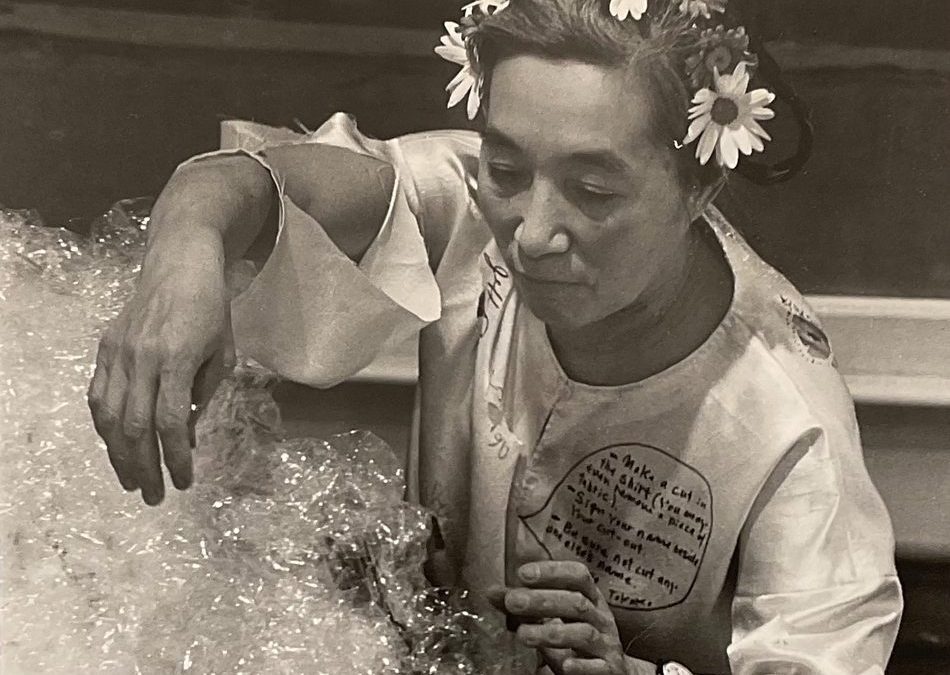
It was announced on 30 September 2025 that Takako Saito sadly passed away. Her death marks the loss of one of the last first-generation Fluxus artists, but her playful spirit and inventive approach will undoubtedly continue to resonate in the ways that contemporary artists and audiences — not to mention curators, conservators, and other cultural…
-

Welcome to Sara Duborg Døssing
This fall, our Activating Fluxus team is pleased to welcome Sara Duborg Døssing as a guest researcher. Sara joins us from Aarhus University in Denmark and works professionally as a curator at the HEART — Herning Museum of Contemporary Art. Below you can find her short biography and the topics she will be exploring with…
-

Episode 10: ‘When Elephants Fight, It Is The Frogs That Suffer—A Sonic Graffiti’ (2016-2017) by Ben Patterson
The sound installation When Elephants Fight, It Is The Frogs That Suffer – A Sonic Graffiti was conceived by Ben Patterson specifically for documenta 14, which took place in 2017 in Athens and Kassel. Patterson started developing the work immediately after receiving the invitation to contribute and traveled to Athens to visit the site that…
ABOUT OUR PROJECT, IN BRIEF
This research project, which has been funded by the Swiss National Science Foundation at Bern University of the Arts, investigates the objects, events, scores, and ephemera that emerged in the spirit of Fluxus in the 1960s–70s in Switzerland, Europe, the UK, and the USA. Inherently fluctuating by definition, Fluxus rejects any stable, material form. Considering the transitory aspects of Fluxus forms not destined for preservation, and looking through a multidisciplinary lens of conservation, art history, performance studies, heritage studies and museology, our project will advance novel strategies for activating Fluxus through the reconstruction, adaptation and artistic reinterpretation of Fluxus forms.
AIMS AND MEANS
The project has three principal aims : (I) Using examples of collections and individual artworks held in Switzerland and abroad, the project reviews, catalogues, evaluates and systematises the current strategies for exhibiting, conserving and documenting Fluxus. (II) By means of a theoretical investigation of the notions of authenticity, changeability and intentionality and the role they play in the continuing life of Fluxus intermedia, (III) the project advances new strategies for activating Fluxus works through (a) the reconstruction, (b) the adaptation and (c) the artistic reinterpretation of Fluxus forms.

IN DETAIL
Activating Fluxus centers on the lives and afterlives of Fluxus objects, events, and ephemera created in the 1960s–70s in Switzerland, Europe, the UK, and the US. Fluxus transformed creative practice for good, not least by questioning the dominant preconception of the artwork as something that endures unchanged. Inherently fluctuating by definition, the creative outputs of Fluxus reject any stable, material form. While many histories of the post-war avant-garde focus on the implications of nascent conceptualism and performativity for other artistic genres, the proposed project considers the fundamentally transitory aspects of Fluxus forms not destined for preservation. By seeking new ways to engage with the legacy of Fluxus through the lens of conservation, art history, performance studies, heritage studies and museology, this project examines the possibility of activating Fluxus, challenged as it is by its paradoxical coexistence of ephemerality and materiality, with implications for how we conceive of changeable artworks that emerged after the 1960s.
 Activating Fluxus