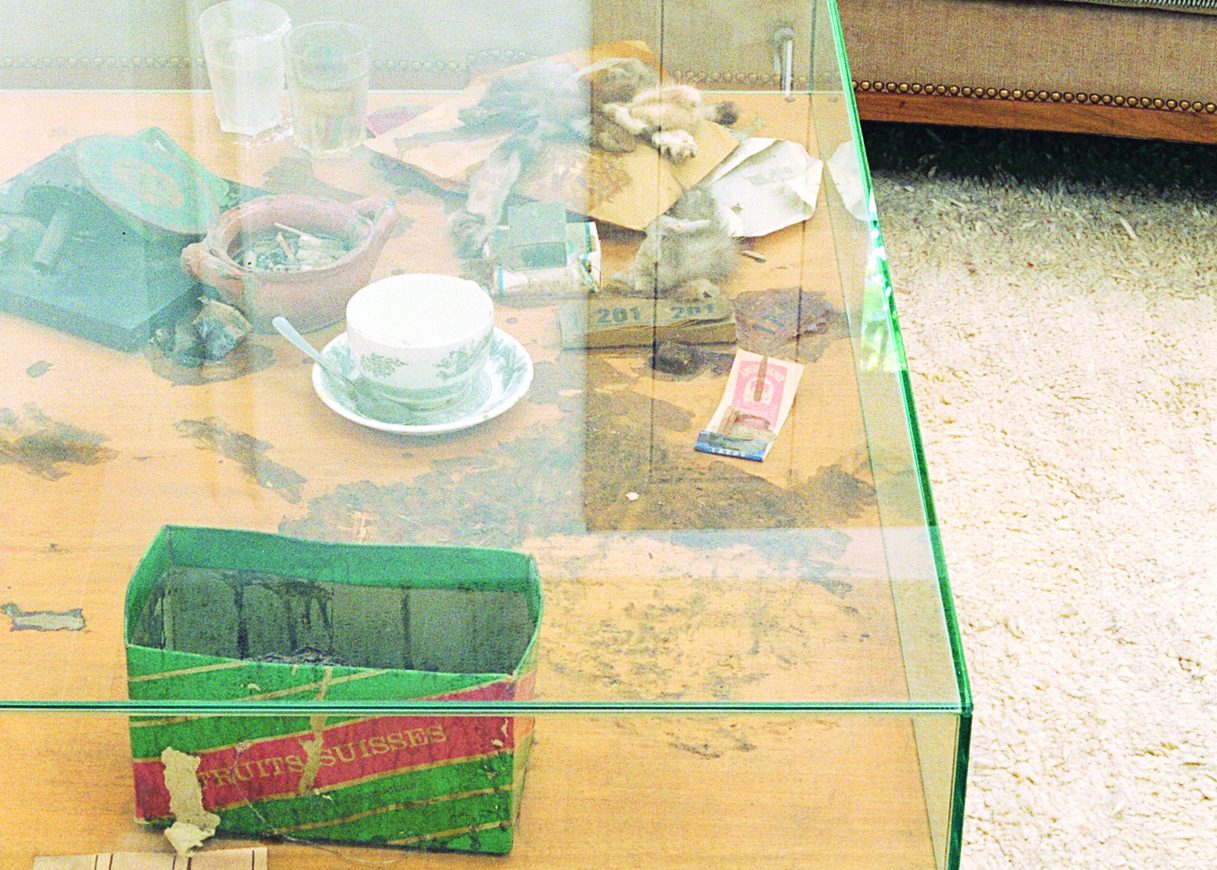
Research and Relationalities: Activation in Practice
This post reflects on systematic research as driver and re-calibrator of activation and conservation of historical artworks in the present.[1] What happens to common research methodologies if they are prompted and pursued in the framework of “activation”, acknowledging (an artwork’s) lively power along what Josephine Ellis most recently called “a continuum of activity” and attuning oneself to its relational being, which is linked to social, temporal and social contexts? [2] What guidance may archival traces, contextual knowledge about chance encounters and relational networks provide in tailoring activation for specific artworks, such as Tischvitrine (tableau piège) from 1969 by Daniel Spoerri?
The “tableau piège” (Fallenbild) is a category of work by Spoerri, whose concept he subsequently developed further over time:
In unordentlichen und ordentlichen Situationen zufällig gefundene Gegenstände werden genau dort, wo sie sich befinden, auf ihrer Unterlage (je nach Zufall – Tisch, Stuhl, Schachtel und anderes mehr) befestigt. Verändert wird nur ihre Lage im Verhältnis zum Betrachter: Das Resultat wird zum Bild erklärt, Horizontales wird Vertikales.[3]
Objects found by chance in situations, no matter whether orderly or disorderly, are affixed to their surfaces (depending on chance—a table, chair, box, or other objects) exactly where they are found. The only thing that gets altered is their position relative to the viewer: the result is declared to be a picture; what is horizontal becomes vertical. (Translation by the author)
Tischvitrine (tableau piège) came into being in the course of a “Feilschmarkt”, an action staged by Spoerri on November 15th, 1969, upon invitation by Theo Gerber, as part of the program of Für Veränderungen aller Art (7-23 November 1969), an exhibition that challenged and repurposed the institutional framework of Kunsthalle Basel under the directorship of Peter F. Althaus.[4]
A conversation between Spoerri and Alfred Richterich, a participating artist who temporarily loaned several items of family-owned furniture to Spoerri, volunteer in the action and future art collector, was recorded. The recording reveals that the objects, their materiality and their position were selected defined in the course of this encounter.[5] The ownership of the piece was also to be transferred to Richterich. After the exhibition’ s closure it was moved to Laufen, a town near Basel, Switzerland, where Richterich installed it in a private building that houses his collection and is accessible only upon appointment [fig. 1].
This move completes a withdrawal from the public realm that is consistent with its genesis and the integrity of the artist collector. This distance from standardized research and conservation practices in institutionalized contexts, allows a closer inspection on the site, sources and relational networks as factors for bringing difference to the conservation and display of Fluxus works more broadly.

Holdings and collections of Fluxus artworks: The site in Laufen
Holdings and collections of Fluxus works were acquired and cared for by specific people living in somewhat peripheral locations, yet alertedly interested in contemporary art. While some of the larger collections like the Gilbert and Lila Silverman Fluxus Collection Archives (MoMA, New York), have since entered the framework of large institutions[6], there are few examples that, relatively unchanged in terms of their location, display and embeddedness into the collectors’ lives, testify to the identity of those who initiated them. Alfred Richterich (*1935) was born into a family known worldwide for the production of Swiss candies in conjunction with a long-standing and transgenerational commitment for acquiring and supporting contemporary art and culture. After commercial training in the family business, and first steps into professional theatre and acting, he became an artist, showing works in international exhibitions after extended stays in Paris in the late 1960s. [7]
At the end of the 1970s he got to know Jacques Herzog through subsequent exhibitions at Galerie Stampa (1979, 1981, 1983, 1986), and Pierre de Meuron shortly after when the two young architects set up their office in 1978. In 1979, he asked them to adapt the architecture and the interiors of a residential building on the property of the Ricola family since generations for the purpose of living with art on an everyday basis. They adapted the two-storey studio apartment of the semi-detached house, the other part of which was inhabited by Lukas Richterich and his family, to the changed needs. Since then, his collection of works and artefacts has been permanently installed in the spatial situation, specified and realised in close collaboration between Richterich and the architects.[8]
Nowadays, it can be visited upon prior appointment in the format of a tour. The tour, for single visitors or small groups, is conceived to unfold as a spatial and durational experience in several chapters, led and accompanied by the curator of the Ricola Family Collection, Roman Kurzmeyer, who not only holds private and professional expertise and deep knowledge about the collection, but is also profoundly familiar with the specifics of the attitude of the collector.

Any tour starts at the threshold between the side street and the fallow version of the front garden of the unobtrusive residential building and leads from the basement floor per floor into the attic. Tischvitrine (tableau piège) fills one room in the basement almost undercover [fig. 2]. It is furnished with a combination of historical furniture, a sofa, coffee table and armchairs typical for a living room in Western culture. A framed portrait-like image on the wall facing the entrance adds to the appeal and the connotation of a domestic interior. The objects on the table are striking in their materialities and are covered with a transparent lid. A historical black-and-white photo showing Joseph Beuys in a semi-public setting is sitting on one armchair [fig. 3]. [9]

Research as Activation : Handling Dispersed Archives and Forms of Evidence
Archival material related to Tischvitrine (tableau piège) is dispersed. Parts that have been published at the time, like the catalogue of the exhibition “Für Veränderungen aller Art” from 1969, are available in public libraries, whereas other written and audiovisual sources of evidence can only be consulted and studied upon appointment. The knowledge about the existence of some material is only to be gained through making research interests transparent and asking for approval to share the key information about their existence and content.
The archive of Alfred Richterich contains a typewritten proposal by Daniel Spoerri for a “Feilschmarkt” planned for 15 November 1969 at Kunsthalle Basel upon invitation by Theo Gerber in the context of the exhibition “Veränderungen aller Art.” This exhibition allowed a group of artists to take stewardship for transforming the Kunsthalle in its appearance, content and function from 7 to 23 November 1969:
“Die hier beteiligten Künstler wünschen die Kunsthalle zu verändern, in ihrem Aussehen, in ihrem Inhalt, in ihrer Funktion. Zweifellos haben sie die Berechtigung dazu – eine Institution, die sich als Informationsorgan der künstlerischen und damit geistigen Tendenzen ihrer Zeit versteht, überlebt sich ungemein rasch, wenn sie sich nicht mit dieser Zeit verändert. Wesentlich war es darum, diesen Künstlern die Gelegenheit zu geben, ihre Veränderungsvorschläge auszuformulieren. Veränderungen welcher Art? Unsere Künstler verzichten darauf – wenigstens für diese Ausstellung – ‘fertige’, in sich richtige Werke, Tafel- oder Standbilder auszustellen. Stattdessen schaffen sie Räume, die eine bestimmte Stimmung erzeugen sollen und auf das Publikum eine bestimmte, bestimmbare animierende Wirkung ausüben.»[10]
“The artists involved here wish to transform the Kunsthalle as institution in its appearance, its program, and its function. It is beyond doubt that they have every right to do so— the Kunsthalle as an institution understanding itself as a source of information about artistic and, by extension, intellectual trends and developments of its time tends to become obsolete very quickly if it does not change in accordance to the contemporary. It was therefore essential to give these artists the opportunity to articulate their proposals for change themselves. Anyone might raise the question: What kind of changes, alterations? Our artists have chosen—at least for this exhibition—not to exhibit “finished,” self-contained works, such as paintings or sculptures. Instead of attuning to conventions, they create spaces intended to evoke a particular mood and exert specific, identifiable, and stimulating effects on the audience.” (Translation of the author)
The exhibition was part of Althaus’ wider programme to, as director of Kunsthalle Basel, challenge conventions and arouse controversies. These ambitions, as well as the exhibition’s critical reception, were documented in the two-volume exhibition catalogue. Together with the historical photo archive of the Kunsthalle Basel, it adds evidence that this action has happened that day between 15.00 – 21.00 h.[11] The archives of Daniel Spoerri which have been institutionalized at The Swiss National Library (Nationalbibliothek Bern) as part of the “Daniel Spoerri archive,” validate that the action took place as meticulously conceived by Daniel Spoerri. The Archive also includes photographs documenting the exchange of objects and recordings of all the conversations conducted by him on site.[12] In the meantime the audio tapes have been digitized and made accessible through PHONOTHEK. [13]
Contingency of Epistemologies: Meticulous Reconstruction and “Genesis” by Chance
All together, the dispersed archives host the main sources of evidence to reconstruct how the Tischvitrine (tableau piège) emerged acknowledging that its “genesis” was not linear, but relational, driven by and dependent on a sequence of chance encounters and relational networks. In parallel with the “Feilschmarkt,” Galerie Handschin in Basel showed works by Daniel Spoerri in an exhibition entitled “Max und Morimal Art”.[14] The same night, the two first exhibitions of Joseph Beuys in Switzerland, opened at Kunstmuseum Basel.[15] Beuys took the initiative to stop by the “Feilschmarkt,” bringing a small knife (“Messerchen”) and a photograph found by his daughter. Spoerri offered him a work by Armand Schulthess in exchange. After Beuys agreed to the transaction, Spoerri shared his personal amusement about a cardboard box bearing the inscription “Suisse fruits” which contained nothing more than an old, dried plum. Beuys refused Spoerri’s offer to exchange it, arguing that doing so would be a breach to the principles of the “Feilschmarkt” from a broader perspective of economics[16].
This packaging, together with a mushroom eaten by worms, had been brought by Richterich. Acknowledging that this was the first economically “valueless” object that evening, Spoerri offered pieces which had been rejected to enter the cycle of exchanges. Richterich accepted, stating a wish:
Richterich: “Mir wäre lieb, wenn sie die Sachen auf dem Tisch aufleimen. Das ist mein Tisch.”
Spoerri: “Mir stinkt es, Dinge aufzukleben.» (…) «So wie es um Neune ist, können Sie es aufleimen. Garantie kann ich Ihnen schon heute geben, einen Garantieschein ausstellen. Das habe ich früher auch schon gemacht. (…) Dieses Objekt, tableau piège, wurde als Reliquie von Feilschmarkt am 15. November 1969 von, wie ist Ihr Name, Fredy Richterich, aufgeleimt. Dann kommt noch die Adresse drauf, weil ich das von allen möchte. Schicken Sie mir dann bitte noch ein Foto. Haben Sie auch UHU Leim? Zementit ist auch gut.»[17]
Richterich: “I’d appreciate it if you glued the items onto the table yourself. That’s my table.”
Spoerri: “After all, I’m kind of sick of sticking things on surfaces.” (…) “Around nine o’clock, you can glue on the items yourself. I approve of this delegation and can give you a guarantee right now—I can issue a warranty certificate. I’ve done that before. This object, *tableau piège*, was glued together as a memento from the flea market on November 15, 1969, by—what’s your name?—Fredy Richterich. Then add the address to it, because I’d like everyone to do that. Please send me a photo as well. Do you have any UHU glue? Zementit is good, too.” (Translation of the author)
Emergence of the artwork: Challenging Notions of Authorship, Ownership and Participation
The recording of the conversation between Spoerri and Richterich reveals not only that Tischvitrine (tableau piège) emerged in co-authorship between the two, but also that Richterich’s part in this particular instance of a “Feilschmarkt” and its afterlives extended beyond the work’s creation, yet in a more private capacity. The table and the seating consisted of heritage pieces from the Ricola family that Richterich temporarily loaned to the exhibition at Kunsthalle Basel. The framed historical photograph of Joseph Beuys placed in upright position in the armchair alludes to Beuys’ presence and participation in a coded manner.[18]
Expanding Conservation: Negotiating Visibility and Access
Since its installation in the basement of a private building in Laufen, Tischvitrine (tableau piège) has been cared for and mediated in accordance with Richterich’s attitude towards collecting as an extension of his artistic practice. The work is neither part of an online collection nor publicly advertised, yet remains accessible to those who are interested in the Basel chapter of Fluxus. It is introduced to people who state their interest and are willing to attune to the special conditions of a visit and display.
The work is connected to Kunsthalle Basel as a site of artistic production and social interaction during a particular period in the city’s cultural and artistic life, but also to to identity of Richterich as an artist, friend of artists and collector, whose interests lie less in representation than in the more subtle, experimental and experiential qualities of art, even including questions of display. The decision to incorporate some family-owned furniture into his participation in the exhibition “Veränderungen aller Art” and let them play a role in the “Feilschmarkt” before returning them back “home” demonstrates a continuity between collecting, domestic life and artistic practice.
The archive materials related to Tischvitrine (tableau piège) are partially stored in the private archive of Richterich, but also in public institutions, like the Nationalbibliothek in Bern, where the estate of Daniel Spoerri is stored, catalogued and cared for. These infrastructures of cultural institutions and archives are not passive repositories of documents. They are sites in which people actively sustain, interpret and negotiate these histories as part of their paid jobs and responsibilities, but also through self-intiatiated projects about the holdings, handling and supporting requests from institutions and external researchers.
Tischvitrine (Tableau piège) thus offers a proposition that there are alternatives to activation of historical artworks other than reenactment or renewed performance. It may mean to take agency in sustaining and reassembling relations—between objects, events, people, places, archives and narratives—while negotiating which relations needs to be made fully visible or accessible and investing time in making stately funded access to online resources like Phonothek more known.
References
[1] The content was first presented as “Wrap Up and Concluding Words” on “Day Two: Activations” of “Fluxus Fête: Grande Finale (26-28 February 2026): https://activatingfluxus.com/activations-a-fluxus-symposium-friday-february-27-12-7-pm-cet/ (Last accessed: October 18th, 2026). The research was supported by Roman Kurzmeyer, Johannes Nilo (Sammlung Alfred Richterich), Kristina Pfister (Graphische Sammlung Nationalbibliothek Bern) and the team Ausleihe University Library Basel. Thanks to Hanna Hölling for critical remarks and valuable comments in turning the lecture into an essay.
[2] Hanna B. Hölling and Josephine Ellis, “On modes of activity and activation. An introduction”, in: Activating Fluxus, Expanding Conservation, hrsg. von Hanna B. Hölling, Aga Wielocha and Josephine Ellis, London, New York, 2026, pp. 1-41, p. 11; Josephine Ellis, “Daniel Spoerri’s logic of the multiple and the continuum of active matter”, in: Activating Fluxus, Expanding Conservation, hrsg. von Hanna B. Hölling, Aga Wielocha and Josephine Ellis, London, New York, 2026, pp. 141-164, p. 144.
[3] Daniel Spoerri, «Zum Fallenbild (Tableau piège)», in: Anekdotomania. Daniel Spoerri über Daniel Spoerri, ed. Museum Jean Tinguely Basel, Exh, Cat. Daniel Spoerri – Metteur en scène d’objets”, Museum Tinguely Basel, 16.05. – 02.09.2001, Ostfildern, 2001, p. 94, «Falsches Fallenbild), p. 111, (Lizenz Fallenbilder), p. 126.
[4] «Spoeries Feilschmarkt» Pressemitteilung und Einladung zum Feilschmarkt bei Theo Gerber, Kunsthalle Basel. Typoskript im Archiv Daniel Spoerri, Schweizerische Nationalbibliothek Bern, Anekdotomania. Daniel Spoerri über Daniel Spoerri, ed. Museum Jean Tinguely Basel, Exh, Cat. Daniel Spoerri – Metteur en scène d’objets”, Museum Tinguely Basel, 16.05. – 02.09.2001, Ostfildern, 2001, pp. 161-162; Für Veränderungen aller Art, Exh. Cat. Kunsthalle Basel, Basel 1969, 2 Volumes, Vol.1, n.p. (Gerber: Dialoge mit Geisler, Guggenbühl, Hiltbrand, Mösch, F. Richterich, Towar, Zweidler), Vol. 2, p. 34. For an in-depth study, see: When Attitudes Escape Form, Kunsthalle Basel 1969 – 1970, ed. Isabel Zürcher, Kunsthalle Basel, 2005.
[5] Regula Maritz, “’Für Veränderungen aller Art’. Chronik einer Ausstellung”, in: When Attitudes Escape Form, Kunsthalle Basel 1969 – 1970, ed. Isabel Zürcher, Kunsthalle Basel, 2005, pp. 33-54, p. 53, footnote 38: “Die Gespräche wurden aufgezeichnet.
[6] The Gilbert and Lila Silverman Fluxus Collection Archives in The Museum of Modern Art Archives. https://www.moma.org/research/archives/finding-aids/Fluxusf . Last accessed: October 18th, 2026.
[7] Lukas Richterich, “Zur Kunst kommen. Coming to Art», in: Ricola Collection, ed. Ricola Familienholding AG, Roman Kurzmeyer, Laufen, 2016, pp. 4-15, p. 5.See: https://sammlung.ricola.ch/de/history/ (last accessed: October 18th, 2026). For the latest publication about the Ricola Collection, see: Roman Kurzmeyer, Sammlung Ricola. Geschichte und Gegenwart, Zürich, 2026.
[8] Gerhard Mack, «Der zeitgenössischen Architektur voraus. Lenghts Ahead of Contemporary Architecture”, in: Ricola. Herzog & de Meuron. Sieben Bauten. Seven Buildings 1983-2014”, ed. Ricola AG, Gerhard Mack, Laufen 2016, pp. 5-9, p. 5, 6, 8; Kurzmeyer, 2026, pp. 117-144, 121.
[9] For a first-person account of a visit on site, see: “Bei Alfred Richterich in Laufen. Basierend auf einem Interview mit Alfred Richterich von Philip Ursprung. Laufen, 10. November 2000», in: Herzog & de Meuron. Naturgeschichte, hrsg. von Philip
Ursprung, Montréal/ Baden, 2002, pp. 170-176. Sammlung Alfred Richterich, ed. Markus Richterich, Laufen, 2022, pp. 12-14. Daniel Spoerri, Tischvitrine (tableau piège), entstanden in der Ausstellung «Für Veränderungen aller Art» at Kunsthalle Basel, 15. November 1969, 53 x 90 x 65 cm. Büro Schreibtisch von Emil Richterich. Fauteuil aus der Wohnung in der Bäckerei im Städtchen, 1928. Sitzgruppe aus der Wohnung in der Baselstrasse, 1950.
[10] Peter F. Althaus, «Für Veränderungen aller Art…?» , in Ausst. Kat. Für Veränderungen aller Art. Kunsthalle Basel, 7.-23. November 1969, Basel, 1969, n.p.
[11] Für Veränderungen aller Art, Exh. Cat. Kunsthalle Basel, Basel 1969, 2 Volumes, Vol. 2, p. 34.
[12] See: https://www.nb.admin.ch/en/daniel-spoerri-archive (Last accessed: October 19th, 2026).
[13] This material has been digitized and is accessible via access to the “Swiss National Sound Archives”: https://www.fonoteca.ch/cgi-bin/oecgi4.exe/inet_fnbasedetail?REC_ID=1.052&LNG_ID=DEU (Entry: Daniel Spoerri: Feilschmarkt in der Kunsthalle Basel, 1969 (GS1). Last accessed: October 18th, 2026).
[14] Spoerri’s Max und Morimal Art, Exh. Cat. Felix Handschin Galerie, 24.10. – 21.11.1969, Basel, 1969.
[15] See: Dieter Koepplin, Joseph Beuys in Basel: Feuerstätte, Bd.2, München, 2003.
[16] Daniel Spoerri: Feilschmarkt in der Kunsthalle Basel, 1969 (GS1), Gespräch mit Joseph Beuys, Index: 8A2. Last accessed: October 25th, 2026. https://www.fonoteca.ch/cgi-bin/oecgi4.exe/inet_fnbasedetail?REC_ID=1.052&LNG_ID=DEU.
[17] Daniel Spoerri: Feilschmarkt in der Kunsthalle Basel, 1969 (GS1), Gespräch mit Alfred Richterich, Index: 6A5, 7A1. Last accessed: October 25th, 2026. https://www.fonoteca.ch/cgi-bin/oecgi4.exe/inet_fnbasedetail?REC_ID=1.052&LNG_ID=DEU
[18] The photograph was first published in the catalogue accompanying the exhibition “Für Veränderungen aller Art”. Für Veränderungen aller Art, Exh. Cat. Kunsthalle Basel, Basel 1969, 2 Volumes, Vol. 2, p. 34.
Selected Bibliography
Activating Fluxus, Expanding Conservation, hrsg. von Hanna B. Hölling, Aga Wielocha and Josephine Ellis, London, New York, 2026
Magdalena Holdar, Fluxus as Networks of Friends, Strangers and Things. The Agency of Chance Collaboration, Leiden/Boston, 2022 (Studies in Art and Materiality, Vol. 6).
Kunst ins Leben! Der Sammler Wolfgang Hahn und die 60er Jahre, ed. Barbara Engelbach, Susanne Neuburger, Exh. Cat. Museum Ludwig, Cologne, 24.06.-24.10.2017, mumok. Museum moderner Kunst Wien, 10.11.2016 – 24.06.2018, Cologne, 2017.
Gergely Ligetfalvi, Daniel Spoerri. Leben und Werk, Cologne, 2016.
When Attitudes Escape Form. Kunsthalle Basel 1969-1970, ed. Isabel Zürcher, Kunsthalle Basel, Frankfurt am Main, Basel, 2005.
Anekdotomania. Daniel Spoerri über Daniel Spoerri, ed. Museum Jean Tinguely Basel, Exh, Cat. Daniel Spoerri – Metteur en scène d’objets”, Museum Tinguely Basel, 16.05. – 02.09.2001, Ostfildern, 2001.
Bilder einer Ausstellung. Le Musée sentimental de Bâle von Daniel Spoerri, fotografiert von Christian Vogt, Eine Ausstellung im Museum für Gestaltung, Basel, 30.9.1989 – 14.01.1990, ed. Galerie Littmann, Basel, 1992.
Stichworte zu einem sentimentalen Lexikon um Daniel Spoerri und um ihn herum. Zusammengestellt, beschrieben und herausgegeben von André Kamber, Exh. Cat. Travelling Exhibition Musée national d’art moderne, Centre Georges Pompidou, Paris, 06.03.- 06.06.1990, Musée Picasso, Antibes, 08.06.-03.09.1990, Museum moderner Kunst, Museum des 20. Jahrhunderts Wien, 20.09.-18.11.1990, Städtische Galerie im Lenbachhaus und Kunstbau München, 11.12.1990- 27.01.1991, Musée Rath, Genf, 16.02.-31.03.1991, Kunstmuseum Solothurn, 20.04.-16.06.1991, 1991.
Freunde + Freunde. Friends + Fruend. Karl Gerstner. Diter Rot. Daniel Spoerri. André Thomkins und Freunde, ed. Karl Ruhrberg, Ausst. Kat. Fruend. Friends. Freunde und Freunde, Kunsthalle Düsseldorf, Juli 1969, Stuttgart, 1969.
Featured image:
Daniel Spoerri, Tischvitrine (tableau piège), co-created in the exhibition “FürVeränderungen aller Art” at Kunsthalle Basel, 15 November 1969, 53 x 90 x 65 cm. Photo: Eva-Christina Meier, 2022