

‘When Elephants Fight, It Is The Frogs That Suffer—A Sonic Graffiti’ (2016-2017) by Ben Patterson – Radio Fluxus: Stories from the Fluxus Archives
The sound installation When Elephants Fight, It Is The Frogs That Suffer – A Sonic Graffiti was conceived by Ben Patterson specifically for documenta 14, which took place in 2017 in Athens and Kassel. Patterson started developing the work immediately after receiving the invitation to contribute and traveled to Athens to visit the site that had been proposed for the work’s location. The work was outlined in detail in an email to artistic director of documenta, Adam Szymczyk, dated March 23, 2016, in which Patterson instructed:
Re-populate the whole garden with invisible frogs! That is to say, introduce frogs that can only be heard! The mechanism for realizing this could be quite simple…perhaps 20+ amplifiers/speakers spread around the gardens broadcasting a ‘symphony’ of croaking frogs. This ‘symphony’ would be composed of real frog croaks…and a chorus of humans trained to imitate frog croaks…The sounds produced by these ‘human frogs’ would be lightly camouflaged political messages—short texts, sentences, proverbs (such as ‘When elephants fight, it is the frogs that suffer’) intoned to sound like frogs calling. This ‘symphony’ would be omnipresent throughout the garden, but not overwhelming or abusive…a kind of ‘sonic graffiti’…
Development of the work was disrupted by the artist’s sudden death in June 2016 and was undertaken again by the artist’s estate in collaboration with Nassauischer Kunstverein Wiesbaden (NKW) and Berlin-based composer Bernd Schultheis.
In this episode, Elke Gruhn—art historian, former director of the Nassauischer Kunstverein Wiesbaden, and longtime friend of Patterson—recounts the story of realizing the work in Patterson’s absence, revealing details of gathering and arranging the components of the sound piece and translating the artist’s instructions into site-specific installations mounted in Athens and Kassel. Gruhn reflects on the challenges related to unavoidable speculation on the artist’s intention, technical difficulties presented by the two distinct sites of documenta 14, and the subsequent inclusion of the work in the collection of the Art Institute of Chicago.
The episode concludes by envisioning the work’s future possibilities, including reinterpretations of Patterson’s ‘score’ in entirely new contexts—across different geographic locations, socio-political discourses and publics. With over 7,700 frog species worldwide, some producing calls in ultrasonic frequencies beyond human hearing, the potential for exploration remains vast and largely untapped.
Work’s biography
Title: When Elephants Fight, It Is The Frogs That Suffer—A Sonic Graffiti
Date: 2016-2017
Artist: Ben Patterson
Realization of the 2016-2017 iteration for documenta 14: Estate of Benjamin Patterson (Barbro W. Patterson, Elke Gruhn) and Bernd Schultheis
Stereo version recorded for Deutschlandfunk Kultur
Implementation: Bernd Schultheis
Field recordings: Frogs & Friends eV
Vocal performers: Sabine Bode, Stephanie Busse, Valentina Dimitriadu-Karagiannis, Claudia Heidenreich, Christiane Henke, Gerold Hens, Martin Hütten, Keno Graumann, Elke Gruhn, Iannis Karanlik, Barbara Klinker, Joachim Kreimer de Fries, Johanna von Kuczkowski, Alfred Neugebauer, Luzie Nierle, Fanny Chrysostom Papadimitriou, Marina Papoulia, Dr. Barbro Patterson, Elpiniki Reister, Theo Safaris Moschos, Pigi Mormouri, Irmela Splett-Neumann, Ann Nöel Williams
Original soundtracks: Martin Luther King, Nelson Mandela, Barack Obama, Benjamin Patterson
Site specific installations of the documenta realization up to date:
- Christian & Byzantine Museum, Athens (documenta 14); sixteen-channel sound installation; April 8–July 16, 2017
- Küchengraben at Karlsaue, Kassel (documenta 14); twenty-four-channel sound installation; June 10–September 17, 2017
- KunstFestSpiele Herrenhausen, Berggarten / Paradies; Hannover; twenty-four-channel sound installation; May 19–June 3, 2018
- McKinlock Court, Art Institute of Chicago, twenty-four-channel sound installation; Jun 8–October 20, 2019
- SAVVY Contemporary, Berlin; binaural version; March 20–April 17, 2022
- Sequences XI, Rea Time Art Festival, Reykjavík, Iceland; twenty-four-channel sound installation; October 13 – October 22, 2023
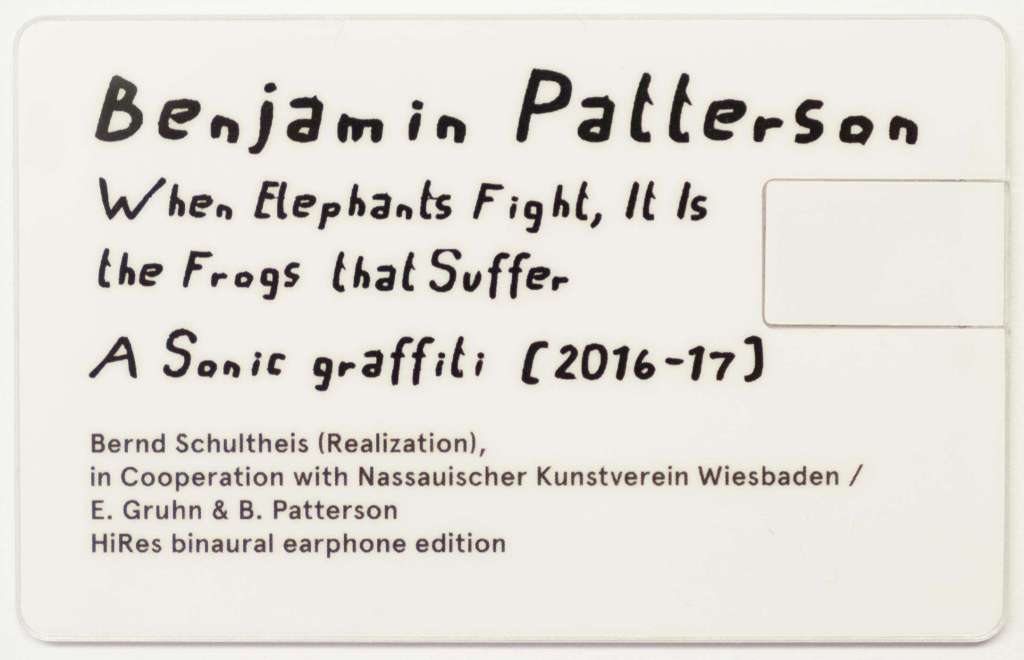
The work exists also as an editioned sound piece for HIRes binaural earphones (PCM 48kHz / 24 bit Soundfile, on USB stick; see: Fig 2)
Components of the “sonic graffiti”
- Frog sounds from field surveys of real frogs
- Frog sounds imitated by choirs (human frogs)
- Frog voices imitated by children
- selected fragments of The Frogs by Aristophanes read by choirs (in German, Greek and English)
- selected fragments of The Frog-Prince by Brothers Grimm, read by choirs (in German, Greek and English)
- Recordings of Ben Patterson’s voice and music from the Ben Patterson Archives
- Recordings by Ben Patterson from the existing material for this work
- Collection of political statements, sayings and proverbs
Benjamin Patterson was an American musician, composer, and performance artist. Born in Pittsburgh, Patterson initially pursued classical music, studying double bass and earning his bachelor’s degree from the University of Michigan in 1956. Due to segregation in the US, he sought opportunities abroad, serving as principal double bassist with the Halifax Symphony Orchestra and touring with the Seventh Army Symphony Orchestra. In 1960, Patterson moved to Cologne after being introduced by composer Karlheinz Stockhausen where he began creating experimental compositions that merged music with contemporary art. Together with George Maciunas, he co-organized the Fluxus Internationale Festspiele Neuester Musik festival in Wiesbaden in 1962, an event widely considered the birth of Fluxus. Patterson participated in Fluxus activities through the 1960s after relocating to New York in 1963. However, experiencing “deep-rooted alienation” in the white-dominated art world, he stepped away from art-making in the late 1960s to pursue “an ordinary life.” For nearly two decades, he worked in arts administration, managing music, theater, and dance companies while serving various arts funding agencies.
Patterson returned to his artistic practice in 1988, moving back to Europe and eventually settling in Wiesbaden in 1992. His practice encompassed performance, sound art, assemblage, installation, video, sculpture, and works on paper. He exhibited and performed internationally until his death, creating a vast repository of scores, paintings, and sculptures while participating regularly in solo and group exhibitions worldwide.
Elke Gruhn is an art historian, curator, and moderator who served as director of Nassauischer Kunstverein Wiesbaden from 2002 to 2023. Her curatorial work focuses particularly on contemporary approaches to activating and extending Fluxus and Fluxus-inspired art practices. Among her notable exhibitions are Living in the State of FLUX/us (2012), which marked the only European retrospective of Benjamin Patterson, and FLUXUX SEX TIES / Hier spielt die Musik! (2022), an exhibition highlighting women Fluxus artists. She is currently Activating Fluxus’ associate researcher.
The legacy of Benjamin Patterson, including the artist’s archive on-site in Hamburg, Germany, publications related to the artist and his website is managed by the Benjamin Patterson Estate.
Sources / References
When Elephants Fight, It Is the Frogs That Suffer – A Sonic Graffiti (2016-2017); Video documentation of 2017 documenta’s 14 iteration in Kassel: https://vimeo.com/220793890?fl=pl&fe=vl&pgroup=plc
When Elephants Fight, It Is the Frogs That Suffer – A Sonic Graffiti (2016-2017); Video documentation of 2017 documenta’s 14 iteration in Kassel: https://www.youtube.com/watch?v=84G5M5kRg2M&ab_channel=VernissageTV
When Elephants Fight, It Is the Frogs That Suffer – A Sonic Graffiti (2016-2017); Video documentation of 2017 documenta’s 14 iteration in Athens: https://www.youtube.com/watch?v=lq2A1755dFk&ab_channel=Byzantine%26ChristianMuseum
Kristin M. MacDonough, “Further Tales of Saving Digital Media,” Art Institute of Chicago website, January 16, 2020, https://www.artic.edu/articles/785/further-tales-of-saving-digital-media.
Carter, Jordan. “Ribbit, Riot: Benjamin Patterson’s When Elephants Fight, It Is the Frogs That Suffer—A Sonic Graffiti.” Oncurating.Org, no. 51 (2022): 122–32. https://www.on-curating.org/issue-51-reader/ribbit-riot-benjamin-pattersons-when-elephants-fight-it-is-the-frogs-that-suffera-sonic-graffiti.html
Russeth, Andrew; The In Sound from Way Out: Benjamin Patterson at Documenta 14 in Kassel and Athens, Artnews, June 8, 2017; https://www.artnews.com/art-news/market/the-in-sound-from-way-out-benjamin-patterson-at-documenta-14-in-kassel-and-athens-8486/
Gruhn, Elke. “Benjamin Patterson / When Elephants Fight, It Is The Frogs That Suffer – A Sonic Graffiti (2016-2017).” Translated by Julia Elizabeth Neil. Nassauischer Kunstverein Wiesbaden, n.d. https://www.kunstverein-wiesbaden.de/en/follow-fluxus/the-scholarship/ben-patterson.
Sources of the additional sound used in this episode:
This episode features excerpts from the work When Elephants Fight, It Is the Frogs That Suffer – A Sonic Graffiti (2016-17) by Benjamin Patterson (Courtesy of the Estate of Benjamin Patterson), including fragment of Barack Obama’s New Hampshire Primary Speech on delivered on January 8, 2008, and of public speech delivered by Martin Luther King Jr. during the March on Washington for Jobs and Freedom on August 28, 1963.
Featured image: Benjamin Patterson, When Elephants Fight, It Is the Frogs That Suffer – A Sonic Graffiti; installation view at documenta 14, Kassel, June 10–September 17, 2017. Courtesy of the Estate of Benjamin Patterson.
 Activating Fluxus