
by Aga Wielocha
“[…] there are very few collectors who will collect them [Year Box], they’re just special collectors of Fluxus things […] But museums don’t buy it [sic]. Now high art is something you find in museums. Fluxus you don’t find in museums. Museums just don’t have it.“
George Maciunas [1]
The situation changed significantly since Larry Miller’s 1978 interview with George Maciunas. While in the recent decades Fluxus works has been collected by numerous museums, this wasn’t always the case. From the late 1960s through the 1980s, the movement’s legacy was largely preserved by a dedicated network of “special” collectors, dealers and art patrons. These visionaries, through their personal acquisitions and tireless advocacy, ensured that Fluxus art would endure and remain influential.
Each time my research on Fluxus takes me to Italy, the importance of its network of care becomes more pronounced. A familiar cast of characters consistently emerges—Rossana Chiesi, Gino Di Maggio, Francesco Conz, and Luigi Bonotto, among others—names that have become synonymous with transmitting Fluxus, not only locally but on a global scale. My latest Italian exploration has uncovered yet another fascinating figure of Fluxus champion who, despite originating from New York circle, has strong connections with Italy. This transatlantic link is Emily Harvey (1941-2004), an American gallerist and, most importantly, a dedicated supporter of artists and art.
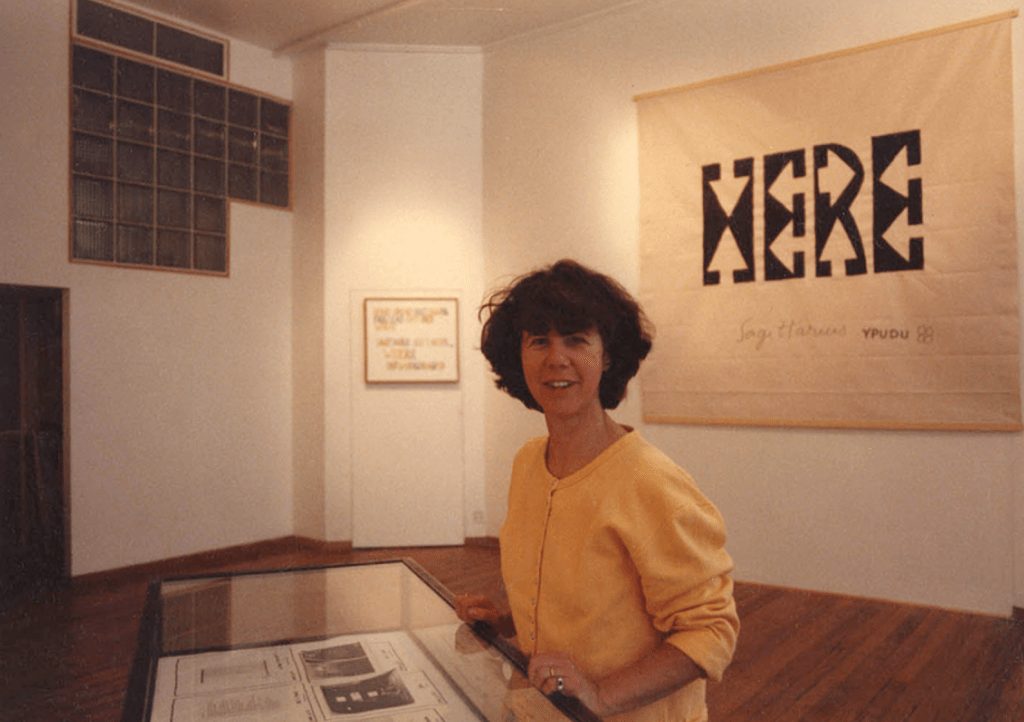
Photo: Christian Xatrec (courtesy Emily Harvey Foundation); source: Munro, Cait. “Legendary Women Dealers You Need To Know, Part Two.” Artnet (blog), March 31, 2014. https://news.artnet.com/market/legendary-women-dealers-you-need-to-know-part-two-6790.
I pen these words from a cozy flat on Calle Ca’ Michiel in Venice, where wooden beams adorn the ceiling and Emily Harvey’s legacy lives on through her foundation’s residency program. This apartment, like many others scattered throughout the San Polo district, once belonged to Harvey herself. Since her passing in 2004, these properties have been stewarded by the foundation she established in her final years, continuing her vision of supporting the arts. The Emily Harvey Foundation offers this residency to international artists, writers, and other creative thinkers in their mid-to-late career—specifically, those 40 years or older. Before immersing myself in this Venetian adventure, my knowledge of the Foundation and its founder was limited. However, I was aware that beyond offering a space for contemplation, creation, and writing in the magical surroundings of La Serenissima, the Foundation also maintains an art space in New York’s SoHo in a loft once owned by George Maciunas.
Let’s begin at the origin of the story and resist the temptation to digress into peripheral topics—however fascinating the interplay of real estate and art may be—and focus on the figure the Foundation’s creator. Emily Harvey’s New York odyssey began in 1964, when she arrived in the city and took on variety of jobs. It wasn’t until 1977, through her marriage to artist Christian Xatrec, that she was introduced to SoHo’s vibrant contemporary art scene.[2] This pivotal encounter led Harvey to shift her career path, becoming an independent art consultant primarily focused on placing artworks in corporate collections.
In January 1982, Harvey launched her first gallery space at 537 Broadway in SoHo. Initially called Grommet Gallery, it was housed in the last of George Maciunas’ New York City artists’ co-ops, which members included Nam June Paik, Shigeko Kubota, Yoshi Wada, Ay-O, and Simone Forti.[3] The gallery, later renamed Emily Harvey Gallery, became a hub for Fluxus-related artists. Jean Dupuy and Olga Adorno, artists who owned the space at the time, collaborated in running the gallery. This period marked Harvey’s introduction to the Fluxus circle, forming connections with artists she would later represent.
When Dupuy and Adorno moved to France in the spring of 1984, Harvey refunded the space in her own name, establishing a commercial gallery that remained committed to the largely non-commercial work—mail art, conceptual art, performance, and video art. She often supported projects with her own funding to help artists realize ambitious proposals. For over two decades of its operation, the gallery presented more than one hundred exhibitions by artists such as Dick Higgins, Alison Knowles, Charlotte Moorman, Ben Patterson, Takako Saito, Carolee Schneemann, Ben Vautier, Emmett Williams, and Yoshi Wada.[4]
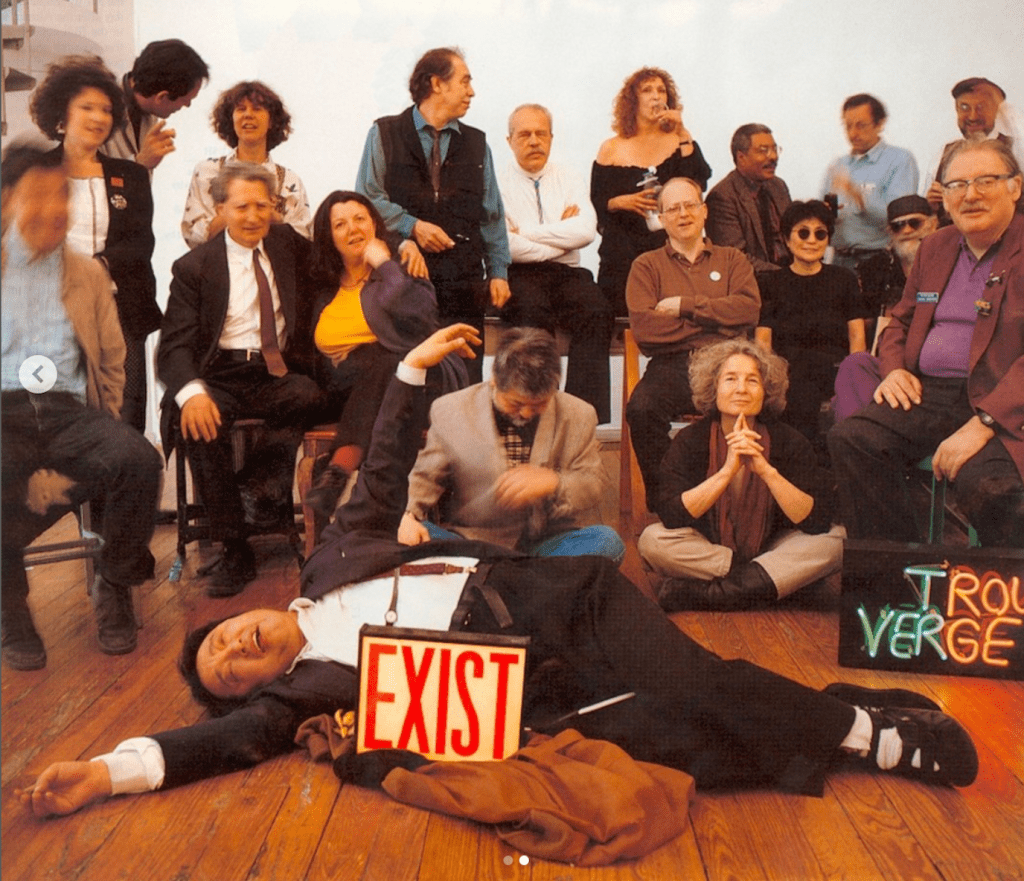
Historical context was of paramount importance to Harvey, who viewed the gallery not just as a commercial space, but as a living archive of artistic practice. When asked why she did not replace the gallery floor, which was old, pitted, and warped in spots, Harvey replied that she could not consider changing it. “Jean Dupuy had built an artwork into it. It had been a surface for innumerable performances by artists she loved. John Cage had walked its length many times in deep discussion.” [5] Now the history of the gallery is also being preserved. In 2022, the Emily Harvey Gallery Archive was acquired by the J. Paul Getty Trust and it is currently undergoing cataloguing and processing at the Getty Research Institute (GRI) in Los Angeles, where it will soon be accessible to researchers and the public.[6]
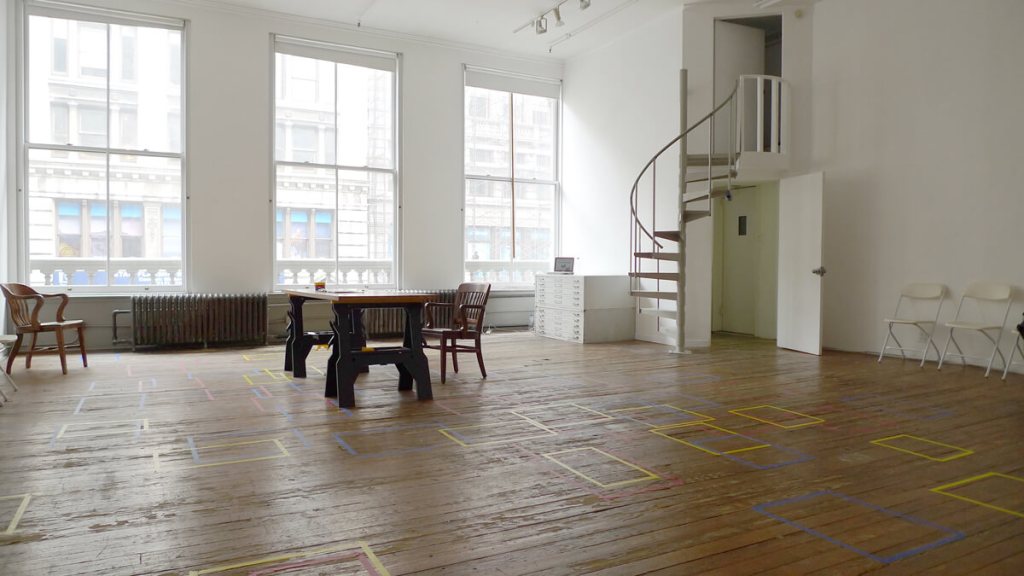
Harvey, who was known for her unpretentious style and often wore her hair in pigtails, forged relationships with artists that transcended mere commercial transactions. Instead, she nurtured a supportive environment investing in their work personally and professionally. Harvey acquired pieces for her private collection, marketed art with reduced gallery commissions, opened her space for performances and communal gatherings, and advised artist-friends on their lives and careers. Carolee Schneemann once said of the SoHo space: “You can always hang around, have a coffee, use the typewriter or even sleep there… It’s an art household—like a church—and we are co-religionists there.”[7]
Emily Harvey passed away prematurely in 2004 after a long battle with cancer. The Foundation was entrusted to her friend, art critic Henry Martin, and two former husbands, Christian Xatrec and Davidson Gigliotti, with the twofold objective to organize the residency in Venice and to run the cultural space in New York. Harvey’s wish was that her loft at 537 Broadway should pass into the Foundation and continue to be used as it was during her lifetime – a space for an experimental art program of performances, poetry readings, screenings, exhibitions, and concerts, as well as a home for her collection. In the final decade of her life, Emily Harvey invested in renovating Venice apartments inherited from her third husband, jeweler and artist Angelo Colombo. Her vision was to transform these spaces into a residency program, designed not only to offer hospitality to artists and writers but also to bring them together in Venice. One of these spaces, The Archivio Harvey, was established from the outset as a nonprofit exhibition venue.
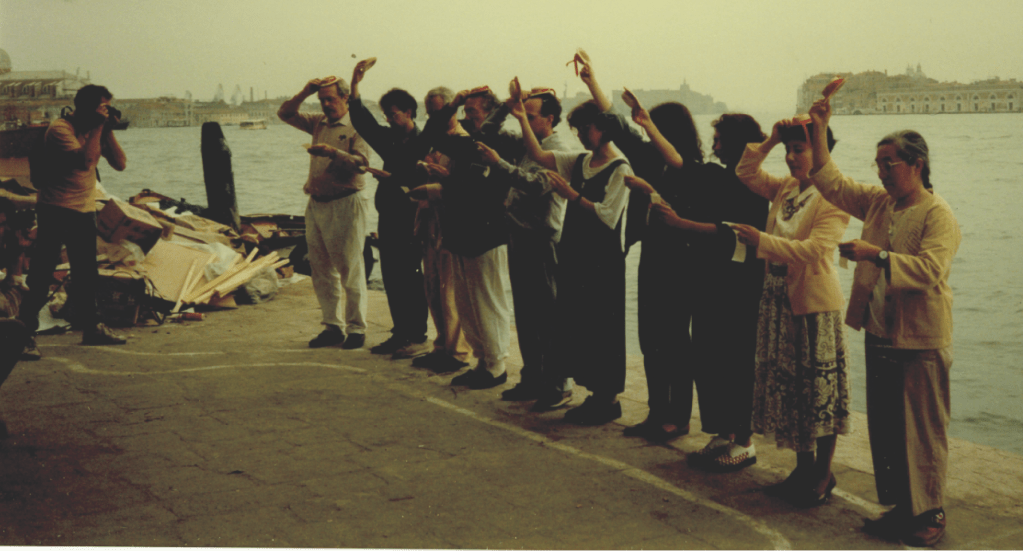
Since its inception, the Venice residency has hosted over 500 creative individuals, including numerous Fluxus artists such as Geoff Hendricks (2005), Ay-O, Eric Andersen, Philip Corner (2007), and Ben Patterson (2016). For me, it provided a unique opportunity to delve deeper into the story of how Fluxus art can be activated through the lens of one very special exhibition that brought many Fluxus artists together in Venice. Titled “Ubi Fluxus Ibi Motus,” this exhibition was organized within the framework of the 1990 Venice Biennale, curated by renowned Italian curator Achille Bonito Oliva and coordinated by another Fluxus patron, Gino Di Maggio.
However, this is a different story that will hopefully be shared soon on these pages.
In the meantime, warm greetings from Venice,
Aga
[1] Larry Miller, “Transcript of the Videotaped Interview with George Maciunas, 24 March 1978,” in The Fluxus Reader, ed. Ken Friedman (Chichester: Academy Editions, 1998), 197.
[2] Cait Munro, “Legendary Women Dealers You Need To Know, Part Two,” Artnet (blog), March 31, 2014, https://news.artnet.com/market/legendary-women-dealers-you-need-to-know-part-two-6790.
[3] “The Grommet Gallery,” The Emily Harvey Foundation, accessed September 20, 2024, https://www.emilyharveyfoundation.org/newyork/Pages/grommetgallery.html.
[4] “Emily Harvey Gallery Exhibitions (1983-2004),” The Emily Harvey Foundation, accessed September 20, 2024, https://www.emilyharveyfoundation.org/newyork/Pages/emilyharveygallery.html.
[5] Gigliotti Davidson, “Dear Friends of Emily Harvey…,” November 23, 2004, https://artistorganizedart.org/emilyharveygallery.artistorganizedart.org/.
[6] See: Emily Harvey Gallery records, Getty Library Catalog, accessed September 20, 2024,
http://primo.getty.edu/GRI:GETTY_ALMA21235451410001551
[7] Matthew Rose, “Planning a Legacy in Venice for a 60’s Art Movement,” New York Times, July 9, 2003, https://www.nytimes.com/2003/07/09/arts/planning-a-legacy-in-venice-for-a-60-s-art-movement.html.
Sources
Davidson, Gigliotti. “Dear Friends of Emily Harvey…,” November 23, 2004. https://artistorganizedart.org/emilyharveygallery.artistorganizedart.org/.
Miller, Larry. “Transcript of the Videotaped Interview with George Maciunas, 24 March 1978.” In The Fluxus Reader, edited by Ken Friedman, 183. Chichester: Academy Editions, 1998.
Munro, Cait. “Legendary Women Dealers You Need To Know, Part Two.” Artnet (blog), March 31, 2014. https://news.artnet.com/market/legendary-women-dealers-you-need-to-know-part-two-6790.
Rose, Matthew. “Planning a Legacy in Venice for a 60’s Art Movement.” New York Times, July 9, 2003. https://www.nytimes.com/2003/07/09/arts/planning-a-legacy-in-venice-for-a-60-s-art-movement.html.
The Emily Harvey Foundation. “Emily Harvey Gallery Exhibitions (1983-2004).” Accessed September 20, 2024. https://www.emilyharveyfoundation.org/newyork/Pages/emilyharveygallery.html.
The Emily Harvey Foundation. “The Grommet Gallery.” Accessed September 20, 2024. https://www.emilyharveyfoundation.org/newyork/Pages/grommetgallery.html.
The Emily Harvey Gallery records, Getty Library Catalog, accessed September 20, 2024.
http://primo.getty.edu/GRI:GETTY_ALMA21235451410001551
 Activating Fluxus