On June 5, 2024, the world lost Ben Vautier, known simply as Ben. His passing, following the death of his wife Annie, left the community of Fluxus artists, scholars, and enthusiasts with a profound sense of loss. Since then, each visit to our project website evokes a reflection for me. The photograph of Ben on the homepage serves as a poignant reminder of the transience of art so closely bound to its creators. What endures is frequently speculative and uncertain—a frozen, decontextualized moment preserved in a photograph.

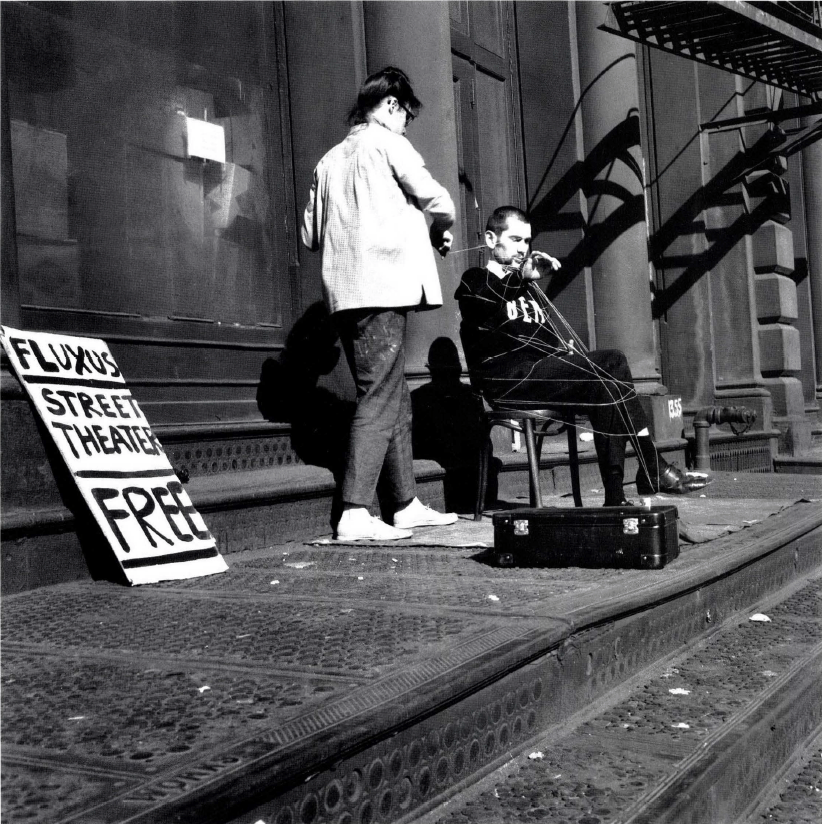
Rather than composing a traditional obituary, I chose to delve deeper into this emblematic image, unpacking what it represents and the circumstances under which it was captured. The photograph portrays Ben seated on a wooden chair against the backdrop of a classical façade. He holds a violin, his body entwined in strings that form a web seemingly connecting him to the building behind. George Maciunas took this image following a performance by Ben and Alison Knowles at “Fully Guaranteed 12 Fluxus Concerts,” a free street festival or “theatre event”—as suggested by the poster leaning against the wall—held in SoHo in May 1964.
The specific details of the performance and the titles of works staged remain unclear, as does Ben’s role. He could have been interpreting Takehisa Kosugi’s Anima 1 (1964), which involves a performer wrapping string around their body. Alternatively, he might have been employed in Knowles’s String Piece (1964), whose score calls for tying up the audience. The violin in Ben’s hands evokes Yoko Ono’s Sky Piece to Jesus Christ (1965), where orchestra members are bound in bandages during a concert, ceasing their playing. However, Ono’s piece was created only a year later.
So why does Ben hold a violin? Is he in the midst of performing Maciunas’ Solo for Violin (1962), in which “a performer might play a sentimental tune, pluck and breaks strings, blow into the instrument’s cavity, fills it with rocks or, […] rip it apart and throw the pieces into the audience”?[1] Or perhaps it is George Brecht’s Solo for Violin, Viola, Cello, or Contrabass (1963), which consists of polishing one of the instruments mentioned in the title?
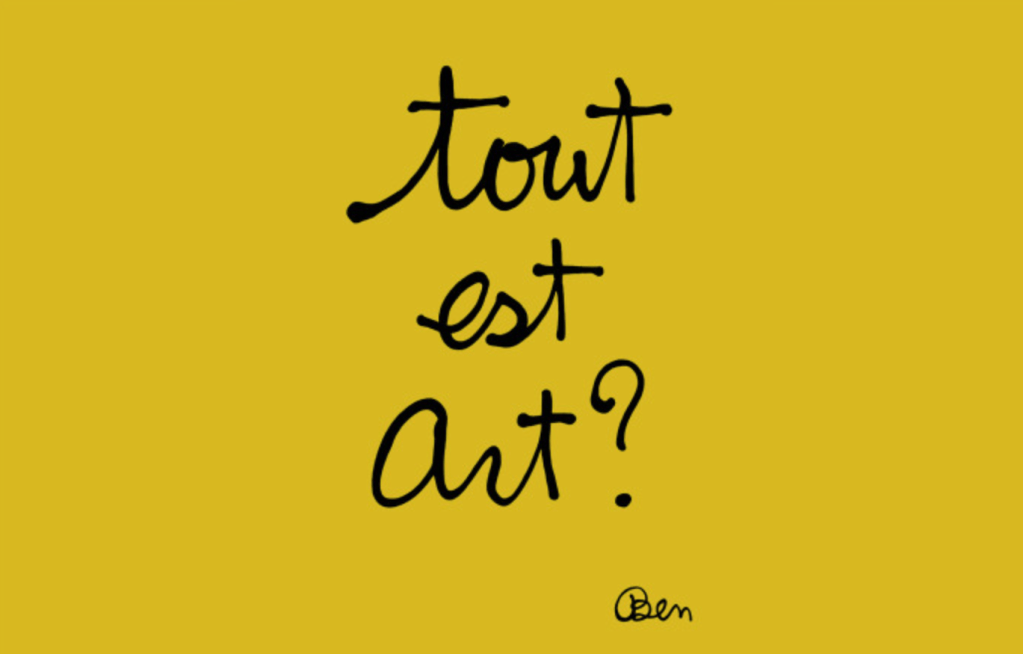
Accounts of the scene vary among sources,[2] leaving us to ponder how events truly unfolded on that sunny spring day among young, passionate individuals who embraced the ethos that “tout est art.” As memories fade and interpretations diverge, perhaps it’s more enriching to let go of the need for certainty and allow ourselves to speculate and imagine instead.
Thank you, Ben, for your remarkable performance.
[1] Harren, Fluxus Forms: Scores, Multiples, and the Eternal Network, 65.
[2] Compare Harren, 175; Kellein, Fluxus, 72; Higgins, 264.
References:
Harren, Natilee. Fluxus Forms: Scores, Multiples, and the Eternal Network. Chicago and London: The University of Chicago Press, 2020.
Higgins, Hannah. “FluxKids (Overview).” Visible Language. Special Issue: Fluxus and Legacy 39, no. 2 (1992).
Kellein, Thomas. Fluxus. London: Thames and Hudson, 1995.
Featured photograph: Poster of Ben’s exhibition at Musée Maillol, Paris (September 14, 2016 – January 15, 2017), source: https://museemaillol.com/expositions/tout-est-art/
 Activating Fluxus