by Mattia Cavoli
Sixty-two years after the foundation of the “non-movement”, it is easy to appreciate how the editorial work of Fluxus was an original aesthetic – a stylistic synthesis – and an effective means of publicizing the group’s many activities and disseminating George Maciunas “Fluxus Editions”.1 In 1963, George Brecht founded the newspaper, V TRE – named after a defective neon sign2 – in conjunction with the activities of the Yam Festival, outside of Fluxus. In January 1964 it became cc V TRE; the prefix code ‘cc’ “indicates that George Brecht was the primary artist behind this endeavour. Later ‘official’ issues dropped this prefix, and Brecht appeared as co-editor.”3

The newspaper was sporadically published between 1964 and 1979 for a total of eleven issues, produced cheaply in newspaper style.4 It was initially edited by Brecht and the Fluxus Editorial Council for Fluxus and finally, there was an “extra” edition dedicated to Maciunas, and edited by Geoffry Hendricks. This came out in March 1979 to commemorate Maciunas’s passing. Most of the group’s editorial expenses were supported by the meagre earnings from the sales of Fluxus objects – promoted by the magazine itself – and therefore often supplemented by Maciunas.
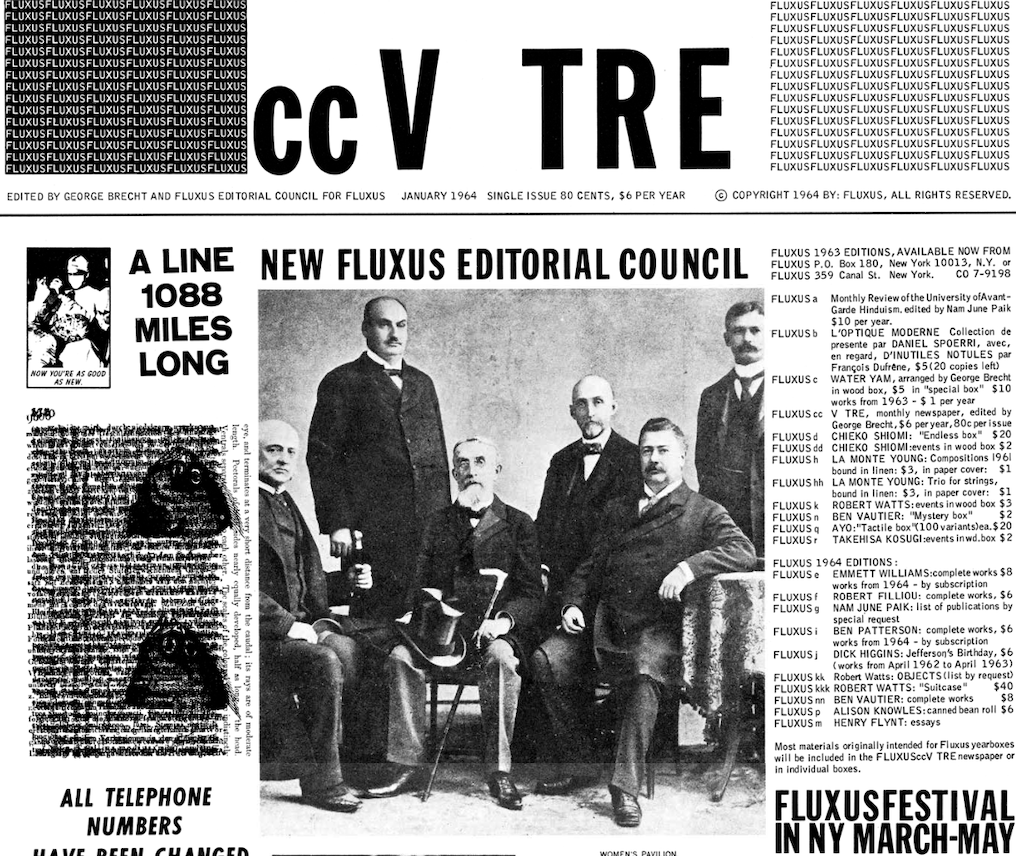
The newspaper is thought of as a stream of consciousness or prodrome of television zapping5, in black and white, and alternates with photos of events and performances, ironic drawings of advertising objects with neo-dada features, ready-mades with the most varied functions, incisive graphics based on lettering, diagrams, schemes6, artistic essays and the sale of objects (real or imaginary). As already mentioned, the first issue, Fluxus cc V TRE Fluxus, came out in January 1964. It presents itself with materials taken from elsewhere which by contrast create ironic-playful tones, “apparently” random combinations, nonsense typical of the Dada7 spirit and then Fluxus, as what, on the front page, should be an old photograph of the New Fluxus Editorial Council (but it isn’t) and which instead shows serious and proud men –probably scientists – elegantly dressed, with walking sticks and black cylinder hats, thick beards and moustaches. On the same page there is a drawing with a strange machine made up of a long tube, which seems to be used for the treatment of constipation, drawings of this nature will also be found in the next issues. Then there is a photo with the lower part of the face of a man with a mustache and a coin between his teeth and the caption “Send those $ to Fluxus”.8 We also find all the information for purchasing the 1963 Fluxus Editions – as happens to a similar extent in almost all subsequent issues – and the promotion of a Fluxus Festival with various events that would take place in New York between March and May 1964: street events, concert hall, film, environments, lectures, etc., by Kuniharu Akijama, Brecht, John Cale, Allan Kaprow, Philip Corner, Maciunas, Ben Vautier and many others.
Scrolling down, on the second page, there is an editorial by Brecht followed by scores composed mainly of instructions such as the one – placed horizontally9 – to perform the Poème Symphonique For 100 Metronomes by György Ligeti, or Mirror by Chieko Shiomi, Swimming Pool Event no. 3 by Robert Watts and then, Piano Suite For David Tudor & John Cage (1961) by Jackson Mac Low. There is also information for where and how you can purchase An Anthology and a photo with the wrapping of a public building by Christo.
Fluxus cc V TRE Fluxus (no.2) of February is very similar to the first issue, both in content and graphics (also in price): there are pseudo-scientific articles, information on the Fluxus Editions for sale, on the Fluxus Festival, a request to send money. On the second page we find a new editorial, Ten rules: No Rules, also by Brecht, which would seem to be “a reminder of the influences of Zen Buddhism on many Fluxus artists”.10 As in the first issue, here too we have a series of scores on the second page: one by Emmett Williams entitled A German Chamber Opera For 38 Marias – the women who will represent it will have a text in Italian and at the end of each sentence they will always have to say “Ave Maria” and then shaking hands before leaving the stage – we then have Composition 1961 no.4 by La Monte Young11, which consists of “draw a straight line and follow it”12, followed by a blow-up of a drop of water falling in a vase and instructions for running Drip Music by Brecht; again, the score of Pond, by Ben Patterson, Solo For Brass by Dick Higgins, etc.
In the third issue cc Valise eTRanglE, from March 1964, we see first of all that Brecht’s name is no longer present as editor but only Fluxus Editorial Council for Fluxus (despite Maciunas having reassured him that “Fluxus paper is entirely your creation”)13 and secondly a decrease in the price (25 cents) compared to the first two issues ( 80 cents).The editorial change is evident from the first page, starting from the notable increase in advertising and publicity material regarding Fluxus activities. On the left, we have several photos of the Fluxus Concert held in Nice and presented by Ben Vautier: One For Violin Solo by Nam June Paik, performed by Ben Vautier, In Memoriam to Adriano Olivetti by George Maciunas, Daniel Spoerri intent on destroying chairs (Chair Pieces) etc. The ever-present drawings of bizarre objects return: a rubber Rowing Machine, recommended for losing weight, a Zip Up Alone, designed for women’s clothes. Then there is a photo of Nam June Paik’s Prepared Piano and a disputed14 Primary Study (horizontal) by Henry Flynt.

The central section becomes a poster that develops vertically. In these two pages we no longer find an editorial by Brecht and the scores, as in the first two issues, but only advertising elements: a photograph of the building that housed the Fluxshop in New York, at 359 Canal Street, a long list of Fluxus objects that can be ordered, a poster indicating the concerts that were also held at 359 Canal Street from 11 April to 23 May 1964, alternating with readings by Dick Higgins.
At the bottom of the last page appears a press release (horizontal), From ‘Culture’ to Veramusement, regarding the picket organized by Flynt, Tony Conrad and Jack Smith (with related photographs) where they proposed to “DEMOLISH SERIOUS CULTURE!”15 and to “DESTROY ART!”16, which took place at the Museum of Modern Art in New York on February 27, 1963. It seems evident that starting from this issue, Maciunas takes control of the magazine and tries again to show Fluxus as a unitary movement. This was not in fact the case, according to the artists: “We all disagreed with George Maciunas when he tried to organize us into a group with a common aesthetic strategy […] We were all against it. He tried to create unity, we disobeyed”.17
Starting from this issue, critics too began to regard the newspaper with suspicion, as a means of propaganda used by Maciunas for the selfish purpose of promoting his own movement. But I will argue that what was really motivating Maciunas was a kind of poetic desire to create unity in diversity. Maciunas sought to create a group able to transcend the individuality of its members, so as to become more than the sum of its parts. This meant that individual works, including his own, should be anonymous18, so as to favor the promotion of the collective. To this end, Maciunas invites the individual artists to help each other: “Fluxus is not an individual impresario & if each does not help another collectively by promoting each other, the Collective would lose its identity as a Collective and become individuals again, each needing, to be promoted individually”.19
Taking Vautier and Jeff Berner as an example, Maciunas explains specifically, in the middle letter addressed to Dick Higgins, what he means by collective spirit: “Whenever they organize events or publish material. (and Ben does a lot of it) He does it as a part of a Fluxus activity. […] I think that is indication of Collectivism. But when people expect me to be the spender and themselves the beneficiaries only, then I assume they consider me to be Fluxus & not a collective, thus anti-collectivism”.20
For Maciunas, the purpose of the newspaper (and of art) is not commercial. Rather, the newspaper serves a pedagogical purpose: to educate people about the uselessness of art.21
Another element that emerges from the newspaper is the editorial choice not to develop the text, photographs, advertisements, etc., only vertically, but to orient them on all four sides – this happened to a greater extent starting from the third issue – so that the “confused” reader had to either rotate the page or physically rotate himself. Using all four sides could be an advantageous escamotage to not “waste paper” and be able to add more elements to the individual sheets, but in some cases, according to Flynt,22 it indicated those writings that did not belong to Fluxus.
The idea of texts placed on the margin of the newspaper and developed horizontally because they are “extra” Fluxus, seems dichotomous compared to what Brecht writes in FLuxus cc fiVe ThReE, the fourth issue, of June 1964, outlining the characteristics of Fluxus as those of a non-movement:
“The misunderstandings have seemed to come from comparing Fluxus with movements or groups whose individuals have had some principle in common, or an agreed-upon program. In Fluxus there has never been any attempt to agree on aims or methods; individuals with something unnameable in common have simply naturally coalesced to publish and perform their work.”23
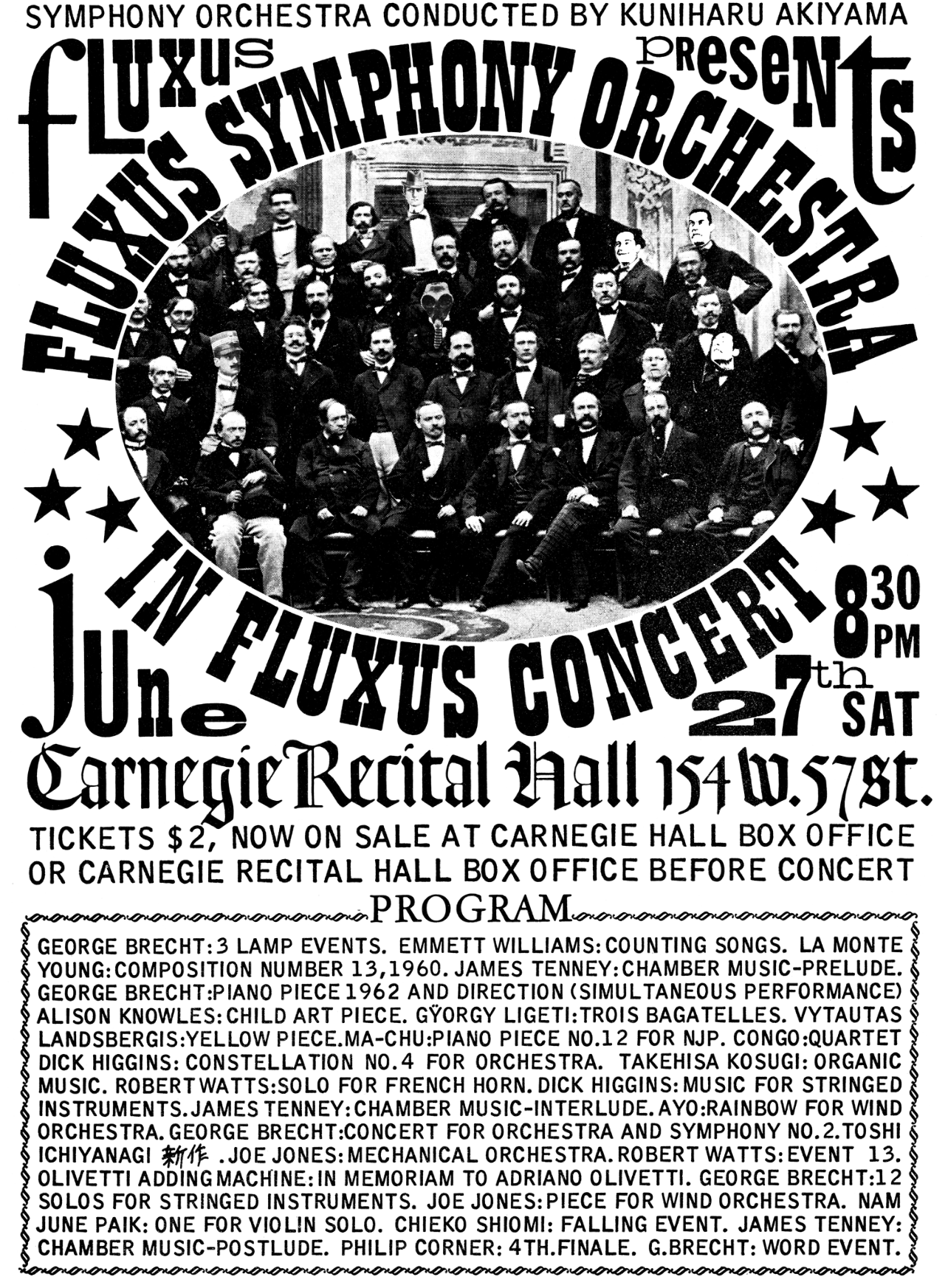
In addition to this short essay extracted from Brecht’s (Something About Fluxus), the first page of the fourth issue is permeated by a text by Nam June Paik entitled Exposition Of Experimental Television, on the exhibition he held in March 1963 at the Galerie Parnass in Wuppertal. The central section is dedicated to the promotion of a concert by the Fluxus Symphony Orchestra at Carnegie Recital Hall, which has a double function: on the one hand it advertises the concert and on the other it can be used as a poster to hang on the wall24; on the last page the new Fluxkits are advertised.
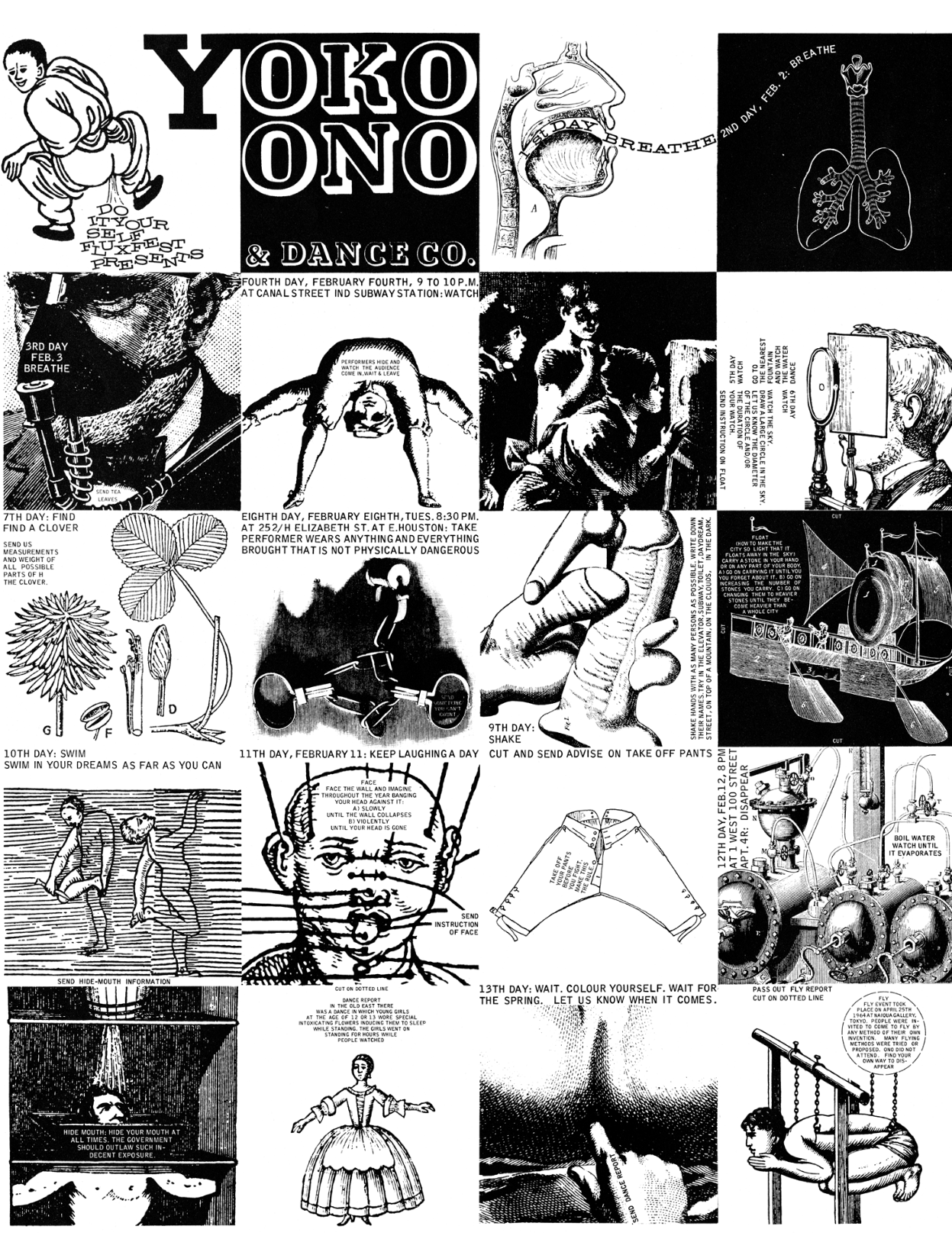
The fifth issue, Fluxus Vaccum TrapEzoid, comes out in March 1965 and is entirely dedicated to Fluxus activities: a Fluxfest organized for June-July in New York, objects for sale in the Fluxshop, and ends with pseudo-scientific articles. It should be noted that the scores and essays have completely disappeared, the same happens in Fluxus Vaudeville TouRnamEnt no.6 of July 1965, permeated by photos and scheduled events. The seventh, 3 newspaper eVents for The price of 1$ (February 1966) is dedicated to three artists: Yoko Ono, Ben Vautier, Jim Riddle. On the front page there are several photos of the Fluxorchestra Concert at Carnegie Recital Hall (1965) and one of Shigeko Kubota performing her Vagina Painting at the Summer Fluxfest. One page is entirely used by Yoko Ono and is entitled Do It Yourself Fluxfest, the ironic illustrations are by Maciunas and depict a series of events conceived by Ono for fourteen days: they range from three days in which you “only” have to breathe, to watch the water evaporate, minimal events, which belong to the sphere of everyday life and which everyone can perform, but which contrast with the images: “If the images themselves are not overtly perverse, their treatment, isolation, or adjacency to other sadistic or exotic illustrations […] lends a malignant ambivalence to them all”.25
Following this, we have a whole page for the Fiftyeight Propositions For One Page (1965) by Vautier, and the next dedicated to Riddle’s One Hour, composed of many photographs of the same pocket watch which starting from eleven o’clock continues until reaching noon. Fluxus Vaseline STREet (no. 8) came out in May 1966 and on the front page promoted a Hotel Event at the Hi Red Center, with misleading, vaguely sacred and alchemical drawings. A page is dedicated to Wolf Vostell (Yellow Page or An Action Page) and concerns a “diet”26 to follow for a month, with the list and addresses of various drugstores and what to eat (with the relative quantities), these are the instructions:
“TAKE THIS PAGE AS AN INSTRUCTION PLAN
WITH YOU DURING ONE MONTH BUY THE
QUANTITIES OF GROCERIES INDICATED IN
THE LEBENSMITTELKARTE (RATION CART)
A THE DESIGNATED GROCERS.
TRY TO SUBSIST THAT MONTH WITH THESE COMESTIBLES ONLY.
INDICATED WEIGHTS ARE FOR EACH COUPON”27

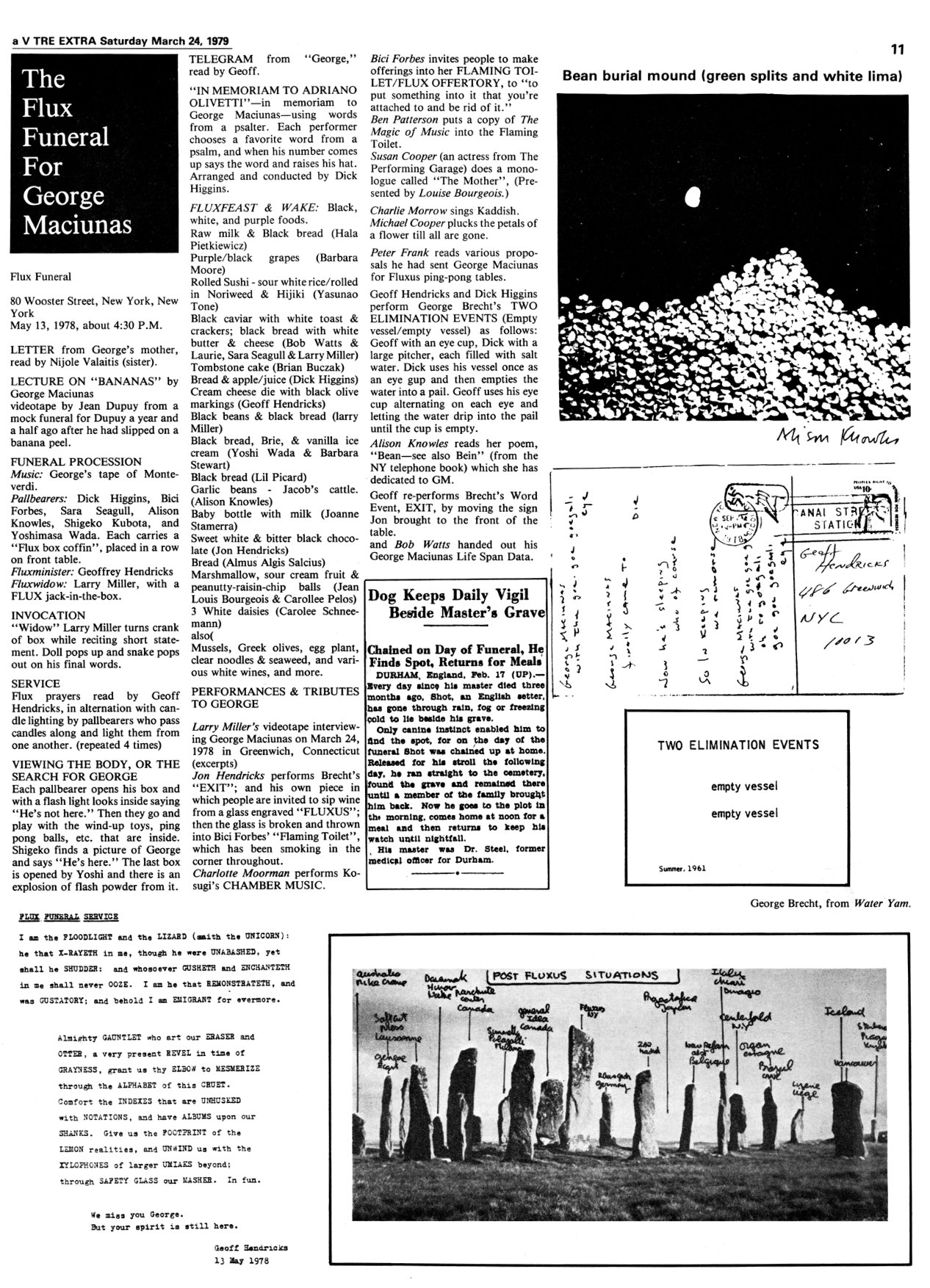
The lack of assiduity in the publications that had characterized the first issues of the newspaper disappeared, in fact after no.8 there will be a four-year break until the next, John Yoko & Flux (1970), and this is mainly composed of documentary photographs taken by Peter Moore of some Fluxfests that took place during that year, and it is the last one that bears the signature of Maciunas. The tenth issue, FLUXUS maciuNAs V TRE Fluxus laudatio scriPTa pro GeoRge, comes out six years later, on 2 May 1976, and is edited by Robert Watts and Sara Seagull, produced by Geoffey Hendricks and the Fluxus Editorial Council for Fluxus. It is dedicated to George Maciunas – probably following the serious attack he suffered on November 8, 1975 – and there are poems by Dick Higgins, Ay-O, a Fantastic Event for George Maciunas by Mieko Shiomi, alternated with scientific articles, photos of nudes female, drawings of different machinery. There are no longer any advertisements for the purchases of Fluxus objects and there is also no promotion of events. The last issue, V TRE EXTRA, released on March 24, 1979, is entirely dedicated to Maciunas, and is posthumous to his death. The front page opens with a parodic photo of Maciunas dressed as the Pope and renamed in the article as the Flux Pope, who died at 92 of a heart attack. There will be several contributions dedicated to Maciunas, including the obituary in different languages, in what is considered to be the last issue of the newspaper.
As can be seen from the analysis of the individual issues, cc V TRE, and then V TRE, was much more than a simple newspaper, but rather can be considered a synthesis of Fluxus on various fronts. Starting from the essays and scores present in the first issues, from the gags and misleading photographs, permeated by strong irony, it then became a documentary source, thanks also to the countless photographs taken by Peter Moore during the Fluxus events. On the one hand we therefore have a “theoretical” part, which informs the reader about what Fluxus is, not only directly – as in Brecht’s aforementioned essay Something About Fluxus – but also in accustoming him to a “Fluxussian” aesthetic-(icono)graphic construction which is already emerging from the first issues. On the other hand, the publication also plays a role in advertising and informing the reader that the “movement” was active on various fronts and in selling the objects of the Fluxus Editions. The decision to concentrate a lot of information in a single medium, beyond the practical, economic aspect, may appear confusing at first sight, but it was also a way “to develop an alternative market outside the normal cultural circuits”28 and make Fluxus known beyond a small New York circle, for example in the German area (and beyond), through Tomas Schmit:
“We are printing a MONTHLY NEWSPAPER now (edited by new Fluxus Council – Brecht, Dick & Alison Higgins & myself). I am sending to you a pack of January issues (50 copies) by sea and one by printed-matter air mail. […] Please distribute it in Germany only, since we are sending separately to all other countries. Send all German contributions to Fluxus P.O. Box. OK?”.29
Upon seeing the first issue of the newspaper, Schmit denounced Maciunas as bourgeois: “The whole paper, looks exactly like what come out if bourgeoisie gets drunk”30,calling it confusing and silly, in the stories and the comics, and concludes: “You simply can’t expect me to distributing that in Germany!! Don’t send me anymore – please look for another fellow doing the distribution!”.31
After this harsh criticism of the newspaper and Fluxus, Schmit was expelled and replaced by Takehisa Kosugi.
As can be seen from the correspondence, Maciunas was always in a great hurry to receive the materials from the artists, to publish the newspapers on time. But artists’ delays led to increasingly sporadic releases. What in the first three issues seemed like a newspaper destined to be published monthly, gradually lost its timeliness as well as its comic nature and pedagogical verve, to become a reportage of the Fluxus events of the past. In recent years, several writings have critically analyzed the Fluxus newspaper. Editoria e Controcultura, for example, highlights cc V TRE’s influence in the creation of other editorial collectives, such as the ‘Italian Ed. 912, founded in Milan in 1966 by Gianni-Emilio Simonetti, Gianni Sassi and Sergio Alberoni, which gave birth to magazine bit (1967-1969). The Fluxus inspiration is evident in bit’s graphics and appearance, in its inclusion of event scores and promotion of Fluxus Concerts. bit brought to Italy a testimony of what had happened in Wiesbaden in 1962 and thereafter.
Fluxus has also attracted the recent interest of amateur collectors, inflating the market price for original copies of cc V TRE. Now that they have become expensive, cult objects, they can only be acquired by an elite of collectors, betraying the original ideal of a newspaper accessible to all. Unsurprisingly, this is happening in a historical moment in which the “non-movement” is experiencing renewed glory and recognition – not always wanted by the artists who took part in it – in both the artistic and academic worlds, where Fluxus had once been disdained. This has created the need to make the newspaper economically accessible. In 2023 Primary Information reissued a smaller format (10,5 x 14 inches) version of it, hoping to lower the price and attract a wider audience. This reprint enables more people to view the sources so important in the development of Fluxus, expanding its audience beyond the niche of late modern art enthusiasts. The reprint is designed to be a “flux”, an unicum of eighty pages in which all the issues of the newspaper alternate.
It should be reiterated that previously the newspaper was only available in the archives, while now it is accessible to the curios, to students, to non-weatlhy enthusiasts, who can thus acquire information regarding the Fluxus journey, from its “golden age” to the end of the Maciunas era.
- George Maciunas, Scritti Fluxus, Patrizio Peterlini, Angela Sanna cur., (Milan: Abscondita Editore, 2023), p. 135. ↩︎
- Simon Anderson, “Fluxus Publicus”, in In the Spirit of Fluxus, published on the occasion of the exhibition of In the Spirit of Fluxus, organized by Elizabeth Armstrong and Joan Rothfuss (Minneapolis: Walker Art Center, 1993), p. 49. ↩︎
- Craig Saper, “Fluxus as Laboratory”, in Fluxus Reader, edited by Ken Friedman (Chichester: Academy Editions, 1998), p. 147. ↩︎
- The number can be extended to twelve, considering the reprint of the first nine issues, published by Flash Art and King Kong International, Milan 1975. ↩︎
- There are similarities with Giuseppe Chiari’s editorial operation in Teatrino (Brescia: Banco Nuovi Strumenti, 1974). ↩︎
- Federica Boragina, Editoria e Controcultura, la storia dell’Ed.912 (Milan: Postmedia, 2021), p.29. ↩︎
- “You will note that 1st page is totally anonymous (no ‘compositions’ of any sort – only ‘ready mades’”. Letter from George Maciunas to Tomas Schmit [January 1964], in Fluxus Codex, Jon Hendricks (Detroit: Gilbert and Lila Silverman Fluxus Collection; New York: Abrams, 1988), p. 93. ↩︎
- Fluxus cc V TRE Fluxus (Fluxus Newspaper no. 1, January 1964). ↩︎
- The positioning of the different texts is polysemous and will be clarified later. ↩︎
- “Fluxus Publicus“, p. 49. ↩︎
- This piece is contained in Compositions 1960 (#10) and Young dedicates it to Robert Morris. ↩︎
- La Monte Young, Composition 1961 no.4, Fluxus cc V TRE Fluxus (Fluxus Newspaper no. 2, February 1964). ↩︎
- Letter from Maciunas to Brecht, October 1963, Archiv Sohm, Staatsgalerie Stuttgart. ↩︎
- “Let me mention that ccV TRE no. 3 (April 1964) […] also contained ‘Primary Study’, my ‘proof that language does not exist, […] Fluxus members complained that ‘Primary Study’ was the last straw”. Henry Flynt, Mutations of the Vanguard. Pre-Fluxus, During Fluxus, Late Fluxus, in Ubi Fluxus, Ibi Motus 1990-1962, Catalogue of the exhibition during the XLIV Esposizione Internazionale d’Arte, La Biennale di Venezia, edited by A. Bonito Oliva, G. Di Maggio and Gianni Sassi (Milan: Mazzotta: Fondazione Mudima, 1990), p. 114. ↩︎
- Henry Flynt, From ‘Culture’ to Veramusement, cc Valise eTRanglE (Fluxus Newspaper no. 3, March 1964). ↩︎
- Ibid. ↩︎
- Sandra Solimano, The Fluxus Constellation (Genoa:Neos Edizioni, 2002) p. 26. ↩︎
- “We would destroy the authorship and make them totally anonymous”. Letter from Maciunas to Tomas Smith, January 1964, in Fluxus etc. /Addenda II, edited by Jon Hendricks (Pasadena: Baxter Art Gallery, California Institute of Technology, 1983)pp. 166, 167. ↩︎
- Letter from Maciunas to Dick Higgins, August 22, 1966, in O que é Fluxus? O que nāo é! O porquê/ What’s Fluxus? What’s Not! Why, by Jon Hendricks (Brasilia; Rio de Janeiro: Centro Cultural Banco do Brasil; Detroit: The Gilbert and Lila Silverman Fluxus Collection Foundation, 2002), p. 175. ↩︎
- Ibid. . ↩︎
- Letter from Maciunas to Tomas Smith, January 1964, in Fluxus etc. /Addenda II, edited by Jon Hendricks (Pasadena: Baxter Art Gallery, California Institute of Technology, 1983), pp. 166, 167. ↩︎
- “My selections were printed sideways to indicate that they had no connection with Fluxus”, in “Mutations of the Vanguard”, p. 128. ↩︎
- George Brecht, Something about Fluxus, FLuxus cc fiVe ThReE (Fluxus Newspaper no.4, June 1964). ways to indicate that they had no connection with Fluxus”, in “Mutations of the Vanguard”, p. 128. ↩︎
- Jon Hendricks, Fluxus Codex (Detroit:Gilbert and Lila Silverman Fluxus Collection; New York: Abrams, 1988), p. 96 ↩︎
- “Fluxus Publicus”, p. 51. troit: Gilbert and Lila Silverman Fluxus Collection; New York: Abrams, 1988), p. 96 ↩︎
- Vostel asks participants to live like a German citizen during World War II. ↩︎
- Wolf Vostell, Yellow Pages or an Action Page, Vaseline sTREet, (Fluxus Newspaper no. 8, May 1966). ↩︎
- Owen Smith, Developing a Fluxable Forum, in Fluxus Reader, edited by Ken Friedman (Chichester: Academy Editions, 1998), p. 17. ↩︎
- Letter from George Maciunas to Tomas Schmit [January 1964], in Fluxus Codex, Jon Hendricks (Detroit: Gilbert and Lila Silverman Fluxus Collection; New York: Abrams, 1988), p. 93. ↩︎
- Letter from Schmit to Maciunas, spring 1963, copy of the original, Collection Archiv Sohm, Staatsgalerie, Stuttgart. ↩︎
- Ibid. ↩︎
BIBLIOGRAPHY
Anderson, S. “Fluxus Publicus”, in In the Spirit of Fluxus, edited by Elizabeth Armstrong and Joan Rothfuss (Minneapolis: Walker Art Center, 1993).
Boragina, F. Editoria e Controcultura, la storia dell’Ed.912 (Milan: Postmedia, 2021).
Flynt, H. “Mutations of the Vanguard. Pre-Fluxus, During Fluxus, Late Fluxus”, in Ubi Fluxus, Ibi Motus 1990-1962, edited by A. Bonito Oliva, G. Di Maggio and Gianni Sassi (Milan: Mazzotta: Fondazione Mudima, 1990).
Hendricks, J. Fluxus Codex (Detroit: Gilbert and Lila Silverman Fluxus Collection; New York: Abrams, 1988).
Peterlini, P and Sanna, A. George Maciunas, Scritti Fluxus (Milan: Abscondita Editore, 2023).
Saper, C. “Fluxus as Laboratory“, in Fluxus Reader, edited by Ken Friedman (Chichester: Academy Editions, 1998).
Smith, O. “Developing a Fluxable Forum”, in Fluxus Reader, edited by Ken Friedman (Chichester: Academy Editions, 1998).
Solimano, S. The Fluxus Constellation (Genoa: Neos Edizioni, 2002).
Featured Photo: Collective, Fluxus cc V TRE Fluxus (Fluxus Newspaper no.1, January, 1964), p. 1.
 Activating Fluxus