by Elke Allgaier
Hanns Sohm (1921-1999) was a German dentist who resided in Münchingen and later, from 1964, in Markgröningen, a small town near Stuttgart. Sohm devoted his personal life to collecting and archiving the avant-garde. In the early 1960s, he became interested in avant-garde publishing ventures and explored, as one of its earliest collectors, art associated with Happening and Fluxus.
In this short digression, I will shed some light on the beginnings of Sohm’s collecting endeavors—a topic I tackled during the conference Activating Fluxus: In and Out of the Archive, coorganized by SNSF Activating Fluxus and Fondazione Bonotto in Colceresa, Italy, in May 2023.
In the early 1960s Sohm focused his interests on contemporary avant-garde activities, especially on the products of small independent publishers. One of the pivotal impulses was his acquaintance with Eremiten-Presse, an unorthodox publishing venture, based in Stierstadt, near Frankfurt am Main. The Eremiten-Presse, which literally translates to “Hermit-Press,” was a hotspot of critical cultural contributions during the post-war period.[1] Consequently, since 1960 onwards, Sohm subscribed to the Streit-Zeit-Schrift, one of the Eremiten-Presse’s quarterly published journals.[2]

In 1962, during a visit to Munich, Sohm encountered Gruppe SPUR, an artistic collaboration formed in 1957 by the German painters Heimrad Prem, Helmut Sturm, and Hans-Peter Zimmer, and the sculptor Lothar Fischer, who published a journal of the same name. Sohm further established contacts with artists such as Wolf Vostell, Hermann de Vries, Daniel Spoerri and Dieter Roth. It is believed that around this time, he transformed from being merely a bibliophile to an avid collector. From then on, he archived every scrap of paper related to happenings, events and the avant-garde. But Sohm did not stop with simply amassing artifacts; rather, he took an archival approach to his growing collection, that is he ordered and filed the materials, assuming the role of an archivist. He also defined his private collection as an archive open to the public.
With his kind openness and interest towards visitors from all over the world, Sohm developed his archive into a focal point for researchers and artists. In his numerous letters he explained the purpose of his efforts. For example, in a letter to Mr. Müller from 1979, Sohm writes:
“lieber herr müller,
dank für ihren brief, ich will mich bemühen, ihre fragen zu beantworten: mein archiv besteht seit 16 jahren und umfasst dokumente zur ‘intermedia-kunst’, wozu auch die verschiedenen formen der aktionskunst gehören. andere gebiete sind fluxus, concrete poetry, underground usw……..
ich betreibe alles allein als nebenberuf, insofern verfüge ich nicht über einen karteiapparat wie öffentliche bibliotheken. meine ganze zeit benutze ich zum heranschaffen des materials, das nur zum kleinen teil in buchhandlungen zu bekommen ist, das meiste muss mithilfe von freunden, bekannten und einer riesigen korrespondenz ausfindig gemacht werden. zudem kommen viele anfragen und auch ausleihen usw.
es gibt zur zeit noch kein umfassendes nachschlagewerk über aktionen, wenn auch über teilgebiete. das material ist sehr umfangreich (…)”[3]
“dear mr. müller,
thanks for your letter, i will try to answer your questions: my archive exists since 16 years and includes documents about ‘intermedia-art’, which also includes the different forms of action art. other areas are fluxus, concrete poetry, underground etc……..
i do everything alone as a sideline, so i don’t have a card index like public libraries. i use all my time to get the material, only a small part of which is available in bookstores, most of it has to be found with the help of friends, acquaintances and a huge correspondence. in addition, there are many requests and also loans etc.
currently, there is no comprehensive reference book about actions, even if about partial sections. the material is very extensive (…)”
At times, Sohm recommended standard readings on Happening, Fluxus and Action Art as a starting point for research. These notions — Happening, Fluxus, Action Art– also defined the focus of his collecting interests. With reference to the Cologne publication Happening & Fluxus (1970), Sohm drew attention to a book written by himself. Here, the reader will find a timeline of events from 1959 to 1970, with details on the various locations, the states of documentation and information about the artists.

In 1970, during the exhibition ‘Happening & Fluxus’ at the Kölnischer Kunstverein (Art Association Cologne), Sohm presented his documents as a timeline. He called his project ‘Documentation Street’, drawing inspiration from book streets which show the special arrangements of the book manufacturing process. The ‘Documentation Street’ was a central aspect of the exhibition and shows how Sohm activated his collection and reached out to the public. To present his archival material, he took a very basic and functional approach by using folding pockets which he fixed to the presentation wall. This concept was also adopted in the second iteration of this exhibition at the Württembergischer Kunstverein in Stuttgart in 1971.[4]
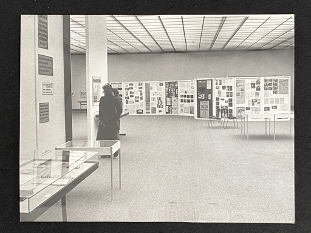
Hanns Sohm: Documentation Street, Stuttgart, photo: Hanns Sohm 1971. Staatsgalerie Stuttgart, Archive Sohm, Inv. Nr. AS 2023/1018,23
Step by step, Sohm sharpened the profile of his archive. After his collaboration with the Kölnischer Kunstverein and Württembergischer Kunstverein in Stuttgart, he redesigned the format of his archive. In 1973, he created a form of a Fluxshop in the basement of the bungalow where he lived with his partner and family and where he ran his medical practice. This space remained the main location where he amassed rare publications, artists’ books, three-dimensional objects, posters and ephemera.
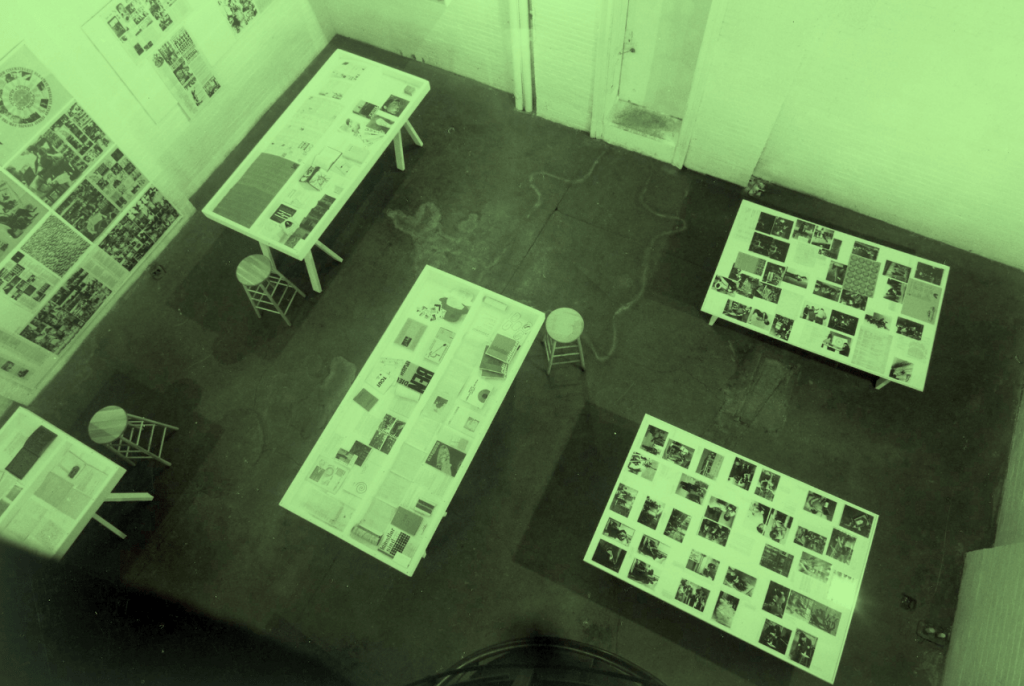
Furthermore, Sohm supported creative approaches towards the presentation of his archival material. In 1975, he agreed to show his collection at the Clocktower Gallery, a temporary exhibition space in Leonard Street, New York. The exhibits were displayed in a relaxed and lively workshop atmosphere. Through these activities, his collection not only acquired an increasingly clear outline, but also a visibly growing reputation. The VillageVoice reported: “Exhibitions like this are a little difficult to digest, because there is no striking visual material, just the mementos of ephemeral events, lots of little scraps of this and that – programs, polemics, photos. But even so, these scraps are evocative of the high humor and mischievous dislocation of preconceptions that this group of international troubadours has brought to the art world.”[5]
In 1981, when the new postmodern building of the Staatsgalerie Stuttgart was under construction, the State of Baden-Württemberg agreed with Sohm to acquire his well-organized, but not indexed archive. The material was described as the “Archive and Collection of Happening, Fluxus, Vienna Actionism, Concrete Poetry, Beat & Underground.” Without delay, a major relocation campaign was launched so that the now legendary 1000 archival boxes, together with correspondence material, artists’ books, AV media, artworks, and graphics, were transferred from Sohm’s residency in Markgröningen to Stuttgart. The move took several years until about 1985, and was overseen by the Staatsgalerie’s curatorial staff. This acquisition prompted the creation of a new basis for the Staatsgalerie’s Archival Department. In this way, an alternative subculture—the archive born out of a passion for the 1960s avant-garde– found institutional anchorage.
After the archive had moved from Sohm’s private premises to the Staatsgalerie, Sohm was keen on exploring further possibilities to make the holdings accessible to the public. In this respect, a new era began for the Sohm Archive. But this is another story.
[1] Martin Ebbertz / Friedolin Reske: Vier Jahrzehnte Eremiten-Presse. 1949-1989. Düsseldorf 1989.
[2] “Streit-Zeit-Schrift” is more than a title – it can be interpreted in different ways, “Dispute-Journal” or “Dispute-Time-Scriptures”. There you find contributions of f.eg. Peter Handke, Bazon Brock, Fritz Bauer and other contemporary thinkers.
[3] Hanns Sohm to Karl Hans Müller, 8.8.1979, Staatsgalerie Stuttgart, Archive Sohm, Inv. Nr. AS 2019/3023
[4] Exhibition „happening & fluxus“: Cologne, Kölnischer Kunstverein (06-11-1970 through 06-01-1971), Stuttgart, Württembergischer Kunstverein (27-01-1971 through 07-03-1971).
[5] Annette Kuhn: Culture Shock, in: the Village Voice, 15 December 1975.
Featured photo: Installation view of the exhibition “Collectors of the Seventies, Part IV: ‘The Sohm Archives – Selections from the Fluxus Section’” at The Clocktower, November 20, 1975 – January 3, 1976. MoMA PS1 Archives, II.A.57. The Museum of Modern Art Archives, New York. INPS1.40.3. Photograph by Peter Moore.
 Activating Fluxus